After coming close to closure last year Drayton Valley’s Toastmasters group is enjoying a new lease of life.
“I am happy to report we are alive, actively recruiting new Toastmasters and recently received two awards,” says Leah Sanderson, past president of the Derrick Toastmasters.
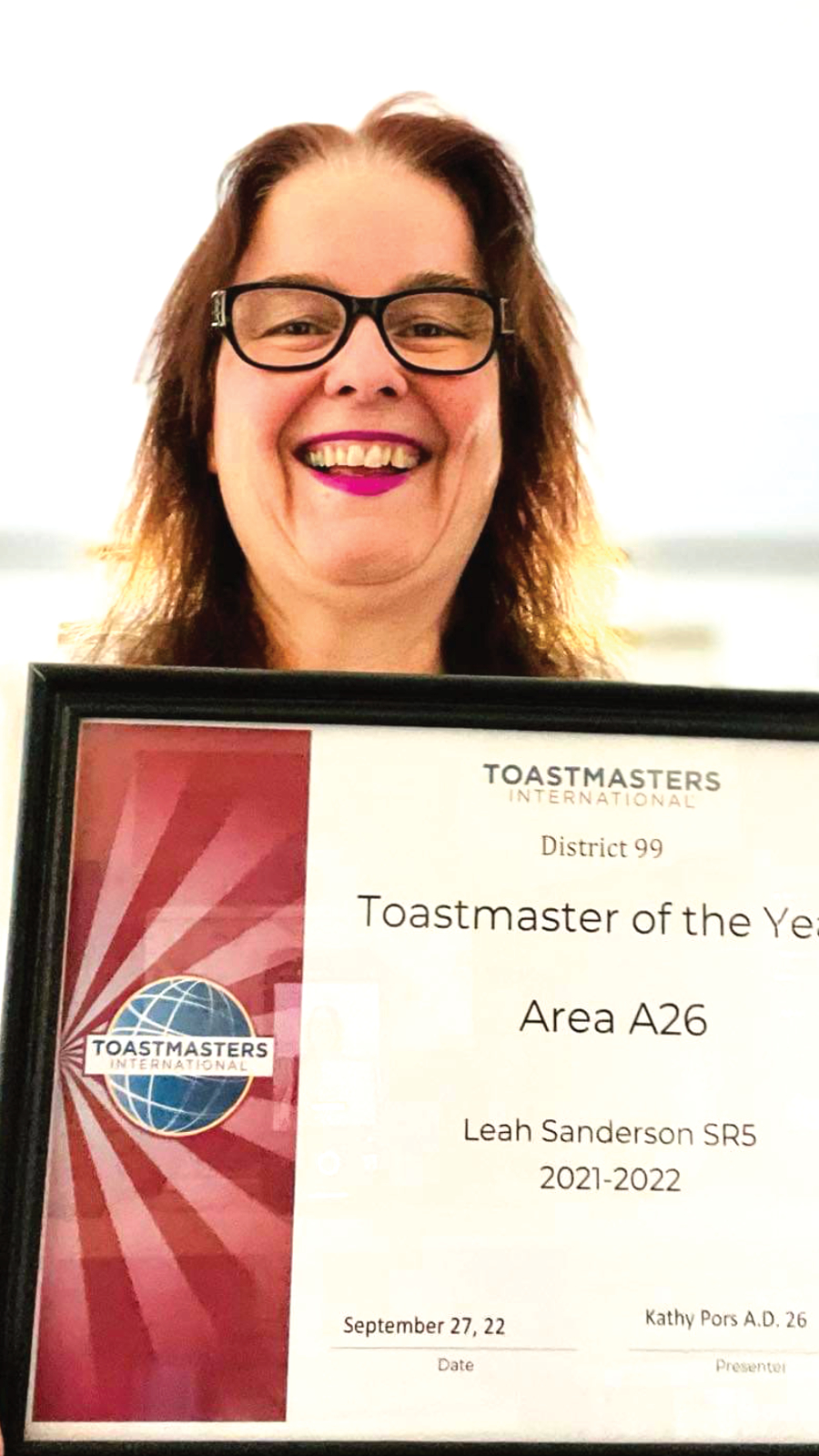
The first of those awards is for public relations, the second is for Toastmaster of the Year, which was won by Sanderson herself.
“The Toastmaster of the Year Award is presented to recognize and honour that Toastmaster in District 99 who achieves and maintains the highest standard of excellence as a member of Toastmasters International,” said Kathy Pors, Division A Director. “Sanderson’s dedication, resiliency, integrity, perseverance and communication achievements are but some of the reasons she is receiving the Toastmaster of the Year Award for 2021-2022.”
Toastmasters International is a nonprofit educational organization that operates clubs worldwide for the purpose of promoting communication, public speaking and leadership. The Derrick Toastmasters have been active in Drayton Valley for 32 years. Last year declining membership left the group’s future in doubt, however Sanderson says things have since improved dramatically.
“Developing leadership skills is not an easy road. What I initially thought was the end of a 32-year charter was actually the beginning,” she says. “I faced and overcame perceived and actual obstacles. As a leader I learned to use being uncomfortable, overwhelmed, at times deflated and defeated to bust through and beyond to that one next step…Each foot forward meant another step towards saving our club and its 32 year charter.”
If you’re a teacher who has just headed back to school I have some bad news. Facebook says you’ve been doing it wrong. Or, to be more specific, you’ve been teaching the wrong stuff.
According to something I read on the social media platform, the education system is teaching kids the wrong subjects. And it has been for years.
Facebook obviously wouldn’t just allow someone to publish something without rigorous fact checking. That would be grossly irresponsible. So we have to assume there’s a degree of existential truth to the list of Subjects that Should Be Mandatory in Schools, but I’m not sure what.
I won’t bore you with the full rundown but it includes things like home maintenance, insurance, coding, balancing a cheque book and public speaking.
Wait, what?
Balancing a cheque book was an important skill back around 1990. These days it’s as much use as knowing how to change a roll of fax paper or memorizing your best friend’s phone number.
Keeping up with home repairs is a great thing and you’ll save a bunch of money if you can do them yourself, but as a subject it’s a little vague. Are we talking about changing a lightbulb or pouring a concrete slab for your deck? It would be good to know because one of these things is not like the other.
Insurance? I don’t even know what that means. Sure it can be an expensive mistake if you wind up overinsured. And it can be an even more expensive mistake if you wind up under insured. But I’m not clear on how they’re supposed to teach that in schools when there are so many variables and every case is going to be different.
Coding would be a very worthwhile skill in an increasingly computerized world, but I’m not sure it’s something we all need to be good at, the same as we don’t all need to be doctors, airline pilots or electricians.
And public speaking? Well, don’t schools already teach that? Isn’t that the point of every presentation you were asked to make in front of the class from Grade 1 show and tell onwards?
So if I was a teacher I’d ignore what Facebook says and stick to what I’m doing. You see a lot of criticisms of the high school curriculum, but the standard, traditional subjects have stood us in good stead. Sure, you don’t necessarily end up using everything they teach you in school once you enter the real world. After almost fifty years I’m still waiting for a Frenchman to approach me on the street, say “bonjour” and ask me how old I am or what the time is, but I’ll certainly be prepared if it ever happens.
And the other stuff, reading, writing and arithmetic, is still as important as it ever was. Yeah, we all carry a calculator with us these days, but if you’re trying to figure out whether 600 grams of cheese for $7.22 is a better deal than 450 grams for $5.07, you still have to know how to ask the question before your phone can give you the answer.
Teaching things like that is what school’s for. I hope that never changes.
A local woman has made it to the top after losing the most weight and was named the TOPS Queen for 2026.
Seventy-eight-year-old Pat Thoreson has been a member of the not-for-profit weight-loss club, Take Off Pounds Sensibly, since 1984. After losing the most weight in Alberta this year, Thoreson was crowned the TOPS Queen last May.
“I started out with a weight problem when I was growing up, so I’ve spent a lot of years at it,” she says.
Since she joined TOPS, Thoreson has lost 72.25 lbs, though she says most of the loss was over the past couple of years.
Prior to joining TOPS, Thoreson had tried out a number of different groups in an attempt to achieve results, but with little success. She says she would lose a little bit of weight, but then would gain it back.
Living near Winfield, Thoreson would meet with the club in Bluffton. From spring to the fall, Thoreson would drive herself to the club every week. Over the winter, Thoreson’s husband would drive her so she wouldn’t have to drive in the dark.
As much as the group was about losing weight, the social aspect was also appealing. She says the club was extremely supportive, and she formed a bond with the members, which was one of the reasons that kept her motivated to return.



“We take turns doing programs, and we have contests. It’s just a good support club,” she says. “That has been another thing that has gotten me to this point.”
One of the women Thoreson met was Violet Schmidt, who was Queen in 1995, and the two became very close.
“Over the years, she was one of the best supporters that I’ve ever had,” she says.
Unlike other groups, Thoreson found the approach of TOPS refreshing. Each week there was a weigh-in for the members, similar to other organizations, but they focused on making healthy food choices rather than food or calorie restriction.
“It’s a food exchange,” says Thoreson. “It’s not that you can’t eat certain foods; you just think about the amount of calories and that type of thing.”
She says they allow themselves to eat the food, but just remain conscious of how much and how often they ate it.
It’s also cheaper than many other programs. To join TOPS, there is an annual fee of $49 USD. Thoreson says her club, which has since relocated to Hoadley, also charges a $5 fee for each meeting to cover the costs of the coffee and rental space. Other than that, there are no fees for information packages and no meals that have to be purchased.

Thoreson says the biggest weight loss came after she received an award for being part of the club for 40 years.
“I thought, ‘40 years and I haven’t really done a whole bunch,’” she says. “That’s one of the things that kind of shook my memory that this was why I was really here, not just to visit.”
She says she lost weight at a healthy pace and was able to keep it off thanks to the information she had from the group and the exercise regime that she stuck to.
“On Mondays, [my husband and I] would floor curl in the afternoon. Then on Tuesdays and Thursdays I do chair exercises for one hour in Buck Lake on Tuesdays and Winfield on Thursdays. Then on Thursdays I would walk for three-quarters to an hour at Winfield as well,” says Thoreson.
As a Queen, Thoreson says she would like to advocate the importance of healthy choices to people.
“A person can do it if they just stop and think about what they’re eating and what they should be eating,” she says. “Even though it took me 42 years, I still go there. It’s not like you have to do it all of a sudden.”
Thoreson says she hopes people will hear her message and make time to attend a meeting at a nearby club to see what the organization is all about.
More information about the program can be found at www.tops.org.



Please be a predictable pedestrian
I remember when I let my kids walk to school alone for the first time. I stood in our big front window waving, and blowing kisses fighting the urge to jump in my car and follow them. I told myself repeatedly that if I didn’t get a call from the school wondering where they were, they must have made it safely and they did.
The route to school from our home on 54th Ave was pretty calm for the most part except for three crossings. The first was crossing the road that the old pool was on from west to east. There was no cross walk and it had some blind spots. People often picked up speed while driving and I would really hammer it into the kids’ heads “Stop, look and listen! Then get eye contact.” The other two crossings closer to St. Anthony School did have traffic lights, however some drivers liked to make that right hand turn while they were looking left. Again “Eye contact!” I wanted my kids to know the responsibility of being a pedestrian, after all we lived in town and walking was something we did often. I never wanted them to implicitly trust that the driver saw them, or wasn’t distracted. They needed to be predictable and patient for drivers. That first walk happened three years ago and my, how times have changed.
Whereas, before I directed much of my annoyance and outrage at drivers, now it’s the “pedestrians,” who aren’t actually on foot. I’m talking about people on an e-anything who zip and zoom from sidewalk to the roads, and who don’t make eye contact, don’t act predictably and generally are not respecting the rules of the road or the sidewalk.
Do I sound like a Karen? I hope so.
A few weeks ago I was walking to the library from the office, and there was a truck at the fourway stop to my right. I made eye contact, looked both ways and proceeded to walk. Then out of the blue to my left, an electric scooter came off the sidewalk onto the road, cut off my path of walking and zipped through the intersection, without stopping thereby cutting the truck off too. In this one instance not only could the person have hit me, but the truck that was ready to proceed could have gunned it and hit him.
Seinfeld is my mindless pleasure. There’s one episode I just watched where Kramer got into blows with a baseball player over a ball cleaning violation on the golf course. Jerry thought he was being too strict with the rules. Kramer’s response. “Hey, a rule is a rule and let’s face it without rules…there’s chaos.” This is what the roadways and sidewalks seemed to have devolved into, utter chaos.
So despite the fact that the current laws on electric anything are murky, and scooters shouldn’t be used off of private property, here they are. And while I would love to deliver the typical PSA to drivers, that says “Hey it is back to school, please watch out for pedestrians.” I also want to shout out. “Hey it’s back to school, please make sure your kids know the rules of the road, how to be a respectful pedestrian that acts in a predictable manner around vehicles, and non-motorized pedestrians! Please!!! For the love of…”
I am not just being a Karen on this one and I would like to put the general reminder that not more than a few years ago we had an e-scooter death in this very town when a scooter driver hit a pedestrian, knocking him down resulting in injury causing death.
So on one hand I would like all drivers to be aware of the pedestrians out on the sidewalk this school season but also, pedestrians or hybrid pedestrians please also do your due diligence and watch for traffic, and be predictable. Lets make sure everyone gets to where they are going in a boring and uneventful way this school year.
Thunder look to balance size, speed and mentality
The Drayton Valley Thunder are getting ready to hit the ice for the pre-season, and head coach Jeff Truit says there will be some changes this year.
Truit, who is in his second season of coaching the team, says there were some lessons to be learned last year.
“I knew that this was a tough league coming in, and with a younger group,” he says. “We learned a lot of lessons in how we have to play and how we have to approach things.”
Truit says it wasn’t anything earth-shattering for him; he was aware there could be some improvements the team needed to work on when he started.
There were a lot of first-year players on the team last year, and so there was some inexperience to contend with.
“I thought last year that we got out-competed at times,” he says.
Heading into camp this year, Truit says they are focusing on bringing in more skill and speed, and they are also looking for bigger players.
“It’s going to be a very competitive camp. I think our scouts have done a tremendous job with the quality of players we’ve got coming in,” he says.


The coaches will be keeping an eye out for some of the taller players with more muscle mass this year. Truit says there is a place for every size of player, but he wants a team that’s a balance of players who are six feet or more and have power and the smaller guys who have the speed.
One of the areas that he saw needed to be improved was their game against the boards. He says the team needs to be able to win those battles. When the players head into that situation, there is a mental aspect to the win. Truit says sometimes size can affect how the player acts in the corners.
“We’re not sacrificing skill because these guys do have skill,” he says. “We look at that being a real positive for our team.”
Truit says there is a fire within every athlete regardless of their size, and each one has to work within the team to make it a success.
A lot of the recruits have worn letters on their jerseys from their past teams. Truit says even though these past leaders are coming into a new level of hockey, they know how to prepare for games and are less likely to get overwhelmed.
“They are very mature young men,” he says. “The nice thing about it is they’ve been leaders, they’ve had to take care of their teams and set the example on and off the ice.”
Truit says last year was a tough year, but as the players have come back, he sees a new level of focus. He says their attitudes have always been great, but they are willing to take on the responsibility of taking the team to another level.
“They know we have to improve,” he says. “They know that the pressure is on. They seem to have grasped that, and that speaks to the quality of their character.”
Truit says there is a mental aspect to the game that the players have to master as well.
“[As an athlete] you have to take it upon yourself to raise that level, and that’s a mindset that you’ve gotta come into,” he says. “And it just feels like now they are going to get it done.”
Truit says he sees the increase in the drive from the players, and he’s really excited about what the upcoming season will bring.
While the role of the captain on the team is an important one, Truit says they are all expected to help with the leadership.
“I care about the collective unit rather than just the captains,” he says.
Truit says one of the best things that fans can do to help the team is to fill the seats during games. He says it can be very intimidating for the opposing teams coming in to hear the cheers for the home team.
He says he believes the fans will be proud of the improvements that have been made to the area, including the taller glass, new clock, and screen. The atmosphere will be different.
“The fans here in Drayton Valley can be a very intimidating group when they’re loud and they’re cheering and supporting that way,” he says. “They did a great job for us last year.”
Make your AI posters newspaper friendly
When I first got into the advertising and sales side of the newspaper I didn’t know anything about anything. But I did know I wanted to make sure that we built our clients effective ads specific to newspaper marketing.
“Newspaper friendly” advertising is a stand alone subset of advertising, just like every social network has their own specs for effective digital advertising, and billboards have their requirements, and radio has their requirements. Newspaper ads that follow certain specs are more effective.
Why is this important for you to know? Because with the rise of AI, we have been getting many AI posters as graphic design submissions for advertising. As a jumping off point for our graphic designer this is fantastic intel, however as a carbon copy ad, these posters are not always newspaper friendly.
A few basic tips I share with people when they are considering submitting a draft design are these:
White space! Newspapers need white space. Too much of everything leads to a whole lot of nothing for the eye to focus on. White space allows your prospective clients to see your important messaging from a distance and draws them in closer to see more once interest is piqued.
Font size. The Free Press type font is 9pt. Advertising should be larger than this. In some cases much larger.
Font contrast. A dark font on a lighter background is the easiest to read. This is why newspapers are black font on white paper. Again this takes us back to white space.
These are the basics that I let people know about. This may mean that your newspaper ad is not a carbon copy of your promotional poster.
But our brand! You might protest.
Branding does not mean placing the same identical ad across multiple mediums. Branding requires you to ensure the big picture aspects of your company are included in all advertising such things like: colours, typeface, image themes etc.
You wouldn’t put a very detailed poster on a billboard would you? No. People driving at 70km per hour don’t have time to read all of the information. But you may put the same headline, with the same colour and similar imagery with a big bold company name. Social media advertising favours not just images but videos – branding may appear in the beginning and end of the video.
If you do choose to draft your ad graphics in AI here are some prompts I pulled from Gemini you could use in that will help make your ad specific to the newspaper medium:
Newspaper prompt guidelines from Gemini
1. Demand High Contrast and Grayscale Clarity
Phrase to include in your prompt:
“High contrast, strong key lighting, bold outlines, optimized for black and white print, crisp grayscale separation.”
Note: you can reference the same but in colour, the colour contrast will be more defined.
2. Enforce Simple Compositions and Ample Negative Space
Phrase to include in your prompt:
“Minimalist background, single clear focal point, uncluttered design, generous empty negative space for text overlays.”
3. Choose Graphic or Vector Styles Over Hyper-Realism
Phrase to include in your prompt:
“Flat vector art style, clean graphic illustration, sharp edges, print-ready layout, high-legibility design.”
One of the services the Free Press provides is graphic design. Our graphic designer on staff, has worked in marketing and has a degree in graphic design. She has a keen eye and great understanding of the importance of typeface, layout, and focal point. If you draft your poster initially in AI send it our way to be rendered into a newspaper friendly format. Provide us with a png or pdf file, unflattened so we can adjust to make sure you are getting the best ad that will catch the most eyeballs.
The fact is the wrong ad style for the wrong medium is ineffective no matter the marketing platform you use. Over at the Free Press, advertising is part of the full newspaper package and we want your ads to be as interesting and eye catching to our readers as our editorial headlines.
Project takes snapshots of historic watering holes
Last Friday the Evansburg Inn was entered into the annals of history by the Beer Parlour Project, which has been making a photographic documentary of historic hotels across Western Canada.
Chris Doering, Rob Pohl, and Doering’s wife Connie Biggart are the founders of the Beer Parlour Project, which aims to record the history of hotels that were the focal point of their community when they were first built. The group wants to capture the essence of the building using a combination of digital and vintage flash photography of the building and the community of people who use it.
“My friends and I are history photographers,” says Doering. “So we go around and document historic buildings, machinery, or whatever the case may be.”
While they were out in the field working, they were often in rural areas. Often there were hotels in the community, some of which were still original structures from the first half of the 20th century, and they would stop in for lunch.
“Right under our noses is all these really interesting hotels with really interesting stories,” says Doering.
The trio started the project in 2022 and have been to about 50 rural establishments since then. Their goal is to visit 100 older hotels across Western Canada so they can publish a coffee table book. They’ve already secured an exhibit at the Alberta Art Gallery in 2028, which they are excited about.
The Beer Parlour group started their weekend on a Thursday at the Colinton Hotel in Colinton, Alberta. From there they drove to Evansburg on Friday, and on Saturday they stopped in at the Warburg Hotel and Saloon.
Though Doering, Biggart, and Pohl all have full-time jobs, this project is their main hobby. The group is funding their project on their own, though they are looking for some arts grants to help cover some expenses. As such, they try to get as many stops in as possible if they have to travel any distance.
Doering says they pick areas to focus on each time they are planning to work on their project. Once they have the area and have selected the hotels, they look into the history of the building and its relationship to the community. They also consider the cultural side of things and how people are involved in the history of the building.
“They’re really little hidden gems,” says Doering. “Outside appearances can be deceiving.”
Doering’s role in the project is digital photography, research, and handling most of the interviews.
“You hear some really amazing stories,” says Doering. “Some hilarious, heart-breaking — you name it.”
Pohl focuses on taking photos, often on his vintage tri-pod camera, and he also helps with some of the writing for the website.
While Pohl’s camera isn’t the best camera for the project, he uses it because he prefers to develop the pictures in his darkroom. It also provides a great ice breaker as patrons come up and ask him questions about it.
“It’s funny, the expectations of people now, especially the younger generation. [They say] ‘Can I see the back of the camera? What does the picture look like?’” says Pohl.


He says people are often shocked that it will take a month for the picture to be developed, but they always offer to send them a complimentary picture when it’s ready.
Pohl says now that they’ve been to a few different bars, had their stories told in the paper, and have been interviewed for television and radio, they can show that they are credible and have a legitimate project that they are working on. This could make it easier to secure grants to help cover some expenses, and it could also make it easier for them to get their work published in a book.
It hasn’t always been easy for them to get people to trust them. For the most part, owners have allowed them to come in, take some photos, and talk to people; however, some have turned them away.
“There is always a little suspicion because they think we’re either gonna portray their place as a dump and try to make fun of it, which we’re not. We’re trying to celebrate it, get people aware of these [places] and out there to enjoy them,” says Pohl. “We don’t use any images or take any pictures in a way to portray it in that light, so we’ve got to get that understanding in place.”
The other suspicion owners sometimes have is that the Beer Parlour Project is going to charge them for the work they are doing, which has never been the case.
The owners of the Evansburg Inn, Christine and Diane Maskell, say they were happy to participate in the project because they believe it’s important for small towns to be recognized and supported.
“Some people don’t even go off of Highway 16, and when they go to these small communities, they’re amazed at what they can find in them,” says Christine.
Christine and her mother-in-law, Diane, have owned the Evansburg Inn for nearly 26 years, and it was only recently that Christine decided to close the bar down on Sundays. Prior to that, she had been working every single day to keep the place going while raising five kids.
The best memories Christine and Diane have are of the people they’ve met along the way. The history of their time running the bar is tied to their memories of their patrons and friends.
Currently, Christine, Diane, Christine’s daughter Lindsey, and her daughter-in-law, Jacey, run the place.
“We do get along really good, honest to God,” says Diane. “They say that mothers-in-law and daughters-in-law don’t get along, but we do.”
The family run business has seen its ups and downs. Their family lost a grandson, son, brother, and husband when Robbie Maskell passed away in 2022.
But still, the women have continued to serve their loyal customer base. Christine is a Jill-of-all- trades, but she doesn’t touch the electrical. She does, however, handle the maintenance for the rest of the building.
“If it’s broken, she’ll fix it,” says Diane.
Over the years, their bar has been known as a place of respect.
“I say, if you respect the place, then I’ll respect you,” says Christine.
In the time they’ve owned the place, there have only been a handful of fights.
Diane recalls a time when Christine had to step in to keep the peace one night.
“There was going to be a fight — this was a few years ago. There was a regular sitting at the bar, and [Christine] knew he was going to go after [another patron]. She jumped over the bar and grabbed him, and hung onto him like you wouldn’t believe,” says Diane.
The bar has become a memorial for some. A bench outside the Inn was placed there in Robbie’s honour, and inside, there is a column filled with messages for a loyal patron who passed away.
“He used to sit in that spot,” says Christine. “He did a lot of plumbing work and help for us over the years we were here, and he suddenly passed away.”
They held a memorial service for Jerry Lee, and his family asked if they could write messages on the wall. Christine pointed them to the area where Jerry always sat, and Jerry’s family and friends left messages for him there.
Several years later, those messages are still preserved, and Jerry is still remembered.
“He had some nieces and nephews that were five or six years old. They’re 18 now and they come in, and they so appreciate that we still have [the messages],” says Christine. “A couple of weeks ago his daughter came in, and she brought her daughter in and they were talking about it. It’s kind of nice.”
Pohl and Doering’s only regret with this project is that they didn’t start sooner. Many old hotels have been closing down in recent years.
“We’ve kind of missed the boat in a way. We should have started a decade sooner and we could’ve gotten a lot more, but we’re going to have no problem hitting 100,” he says.
The group is also really enjoying working on the project, and Pohl thinks they might push past 100 simply because they enjoy it.
More information about the Beer Parlour Project can be found at www.beerparlourproject.com.
A large part of the turnaround is attributed to a public relations program spearheaded by Sanderson and fellow toastmaster Don Stuike. At the time Stuike was the group’s vice-president of education. He has since taken on the role of president.
The pair’s public relations achievements include recruiting and inducting new members, promoting the club within the community and conducting a number of outreach activities.
“These two model what it takes to promote a Toastmasters Club,” says Pors.
Drayton Valley’s Derrick Toastmasters meets regularly every second and fourth Wednesday at 6:45 pm to 9:15 pm using the Zoom platform. Sanderson says new members don’t need any particular skill set. Club members learn by attending free training, taking on roles within the club. There are also a number of free resources offering information, training and guidance.
How do you spend a two week holiday when the weather is crappy? With visitors from Scotland in tow, my wife and I set out to find the answer to that question earlier this month.
After being rained out of Drayton Valley we headed west in search of a break in the clouds. A friend had told me about the Beaver Boardwalk in Hinton. We decided to give it a go and it was actually really good. Basically it’s a long bridge sort of thing that winds its way through an area of wetland. Not only is there lots of wildlife, there’s something weirdly enjoyable about walking on a pathway of wooden planks. It felt a bit like being on one of those old sailing ships, but without the scurvy or the looming threat of a keel hauling.
And the wildlife did come through for us. Hinton provided muskrats along with the aforementioned beaver. When we headed into the national park we had a very good bear sighting (it was good for us, I’m not sure how the bear felt about it) along with elk, a coyote, rabbits and bighorn sheep. And there were lots of deer, although curiously, here at home the little herd of whitetails who are fond of eating my wife’s flowers and defecating on my front lawn were nowhere to be seen.
And talking of wildlife, we were chased away from a rest stop near Obed by a rampaging horde of caterpillars.
One of the good things about the Miette Hotsprings is that it’s really quite pleasant even if it’s raining. The other positive thing about the weather in Jasper was that the waterfalls were in full swing and as spectacular as you could reasonably hope for, even if you did get wet feet trying to get a closer look.
But you can only spend so long trying to see a mountain through a rain spotted windshield. Back in Drayton we found ourselves eating out a lot. I’ve always been a fan of the number and variety of restaurants we have in this community and they did not let us down. However, it will be some time before I can look at a french fry with anything close to enthusiasm again.
During one late lunch we watched Canada play Bosnia Herzegovina at the World Cup. And we splashed out of a TV subscription so we could see Scotland juuussst manage to beat Haiti after 90 minutes of largely ineffectual huffing and puffing.
With sports in mind, our other trip out of town involved a visit to the rodeo in Rocky Mountain House. They have a really nice set up and for once the weather was not completely horrible, so that was a definite bonus.
But the bulk of our time was spent right here at home, and you know what, it was just fine. We shared a few laughs, did a lot of catching up and spent time visiting with my wife’s extremely large family. (When I say “extremely large” I mean there’s a lot of them, not that they’re particularly big as individuals. Most of them aren’t much over five feet.)
So all in all we had a very nice time and I’m looking forward to doing it all again sometime in the not too distant future.
Hopefully when the weather is better.
With Phase II of the development of the Eleanor Pickup Arts Centre underway, the board’s fundraising committee is seeking permission from the Town and County to have a sponsor for the naming rights of the building.
Last week, both the Town and Brazeau County heard a request from the EPAC board to allow Tom and Sheila McGee to start approaching companies about naming rights for the facility. The name of the theatre wouldn’t replace Eleanor Pickup’s name, but would be something like Naming Sponsor Eleanor Pickup Arts Centre.
By giving out the naming rights, the board believes it would be able to raise a significant portion of the costs of the expansion.
The expansion is expected to cost around $4 million. The goal is to cover most of the costs through grants and fundraising, but the McGees think people should focus less on the dollar signs and more on the benefits a larger facility can provide.
The fundraising committee co-chairs are expected to kick off the fundraising at about the same time as the July 17 Charity Golf Tournament sponsored by the Town and County.
They say they have taken on the project because they feel that it’s important that there be opportunities available for people, especially children, who lean more toward the arts than sports.
“I think it’s a big part of our community that we don’t know,” says Tom McGee.
He says there are many talented people in our community who haven’t been able to show off their skills. While the children who play sports have their place, McGee says he believes it’s just as important to invest in a space for other interests.
For him, watching the kids get ready for a performance and then nail their lines on stage is awesome.
“When you see those kids on stage, remembering their lines and doing their work, you just think, ‘Oh my goodness. How brilliant is that?’” says McGee.
Right now, it’s difficult to hold full productions at the EPAC due to a lack of space. There is no green room, which means that cast members don’t have a lot of room to change their costumes or do their makeup. In some cases, trailers have been parked behind the theatre to provide space for the cast to wait until they’re needed on stage.
There are also no washrooms for the cast to use or any space for set storage during a production.
McGee says that when he was on town council in the past, there was some reluctance to close off the walking space between Main Street and the parking lot behind the EPAC. However, his thought on the matter is that it’s not a long walk to go around the buildings rather than through that space.
He also says the expansion would allow for additional revenue, which could help offset some of the costs of the building. Currently, there is a suite above the theatre that gets rented out. With the proposed expansion, there would be room for an additional two suites.
“The argument could be made that it’s sustainable,” says McGee. “It sort of pays for itself.”
He says they will also be approaching the Minister of Tourism and Sport, MLA Andrew Bointchenko, about any possible tourism grants that might be available for the project.
As Graduation is in the air I was inspired to write something for us who haven’t seen the halls of high school for oh…24 years. I felt that maybe it was time for us to hear a hopeful message of our own, just so life doesn’t completely kick the crap out of us.
When I left town after high school I promised never to return. Well here comes the first life lesson: things change.
Things change
We are 24 years beyond grad and are now a generation of adults and parents, who are ushering the next generation through to adulthood. We also are seeing the first signs that our parents are in fact aging and a life lived is more fleeting than we ever understood as a graduate. Some of you have buried parents, grandparents, peers, and children and just as hope was a part of our graduation swan song, reality had made a home in our middle aged lives.
With over two decades of adulting under our belts we know that things do change. We make monumental life changes for jobs, for family, for our children. Mine brought me back to Drayton Valley, yours may have taken you away.
Also you may have come to the conclusion that you are not going to be the first female “insert accomplishment”, or pop star or movie star or whatever predictions your high school year book had made back in 2002. What you did learn is lesson number two; “success” is really hard.
Success is really hard
Not only is being successful tough, it also requires you to make a lot of tough decisions. Do you miss your kid’s baseball game to go to that client meeting? Do you uproot your family to take that management position?
Being successful, however you define it, comes with payoffs and payments. These get more complicated when you are not just considering yourself. This doesn’t mean to quit striving but, it does mean that sometimes giving up old dreams is the right choice Lesson three: collect new dreams.
Collecting new dreams
As you eek your way through mid life you maybe kicking yourself for not backpacking your way through Europe or taking that internship in some far away land. Flog yourself if you must but, after you do that find a way to – just let go. Life is fluid, and so are your dreams and aspirations. Don’t be that monkey who is so focused on holding on to what was, that you never reach for what could be. You are 40, not 40 feet under. Sign yourself up for a sport this fall, take a class, or travel Europe as the sophisticated adult that you are- with some cash in your pocket.
Speaking of cash, there is much said about retirement saving and not much talk about retirement doing. Lesson four; think about your retirement.
Think about retirement
You have been working now for at least 20 ish years and thoughts of retirement planning may be beginning to swirl. I don’t know much about being retired but I do know having a retirement plan is more than just putting some money away.
What the heck are you going to do with all that free time? This will be the most free time you’ve had since…well forever. Start collecting hobbies, friends, and interests that will carry you through into an amazing retirement. Whatever you do, don’t just sit. Lesson five: move your body.
Finally as you are solidly into your forties, maybe you’ve had a couple of kids, been sitting too long at the computer. Your bones may sound crunchy, your muscles saggy and you can see youth and beauty is giving way to wisdom and peri-menopause.
Do not resign yourself to being old, or getting old, not yet my friends! Instead push aside the career dominated goals of high school and move you body. Whenever you get a chance, walk, dance, whatever it takes just move you body, enjoy your body. Your body is not only the greatest instrument you will ever own, keeping it healthy is the greatest gift you can give.
The greatest gift
The greatest gift you can give your kids is not that RESP, you so carefully put away. What you can give them is far more cheaper than that. It’s to be a healthy aging adult- one who can keep up with the grandkids or even live long enough to meet the grandkids, who can go for long walks and talks, and who can do coffee visits not hospital visits.
It is not the responsibility of our kids to make sure our aging behinds stay healthy. That responsibility lies squarely on our shoulders and will be the best gift we can give our kids as we continue to age.
We are 24 years out of high school and with so much life lived and so much life ahead of us. Class of 2002 now is the time to embrace adulthood and enjoy the summer of our lives.
The Drayton Valley Museum is also operating as a Visitor Centre this year thanks to funding from the Drayton Valley Hospitality and Tourism Authority (DVHTA).
Alyssa Kotyk, the Drayton Valley Museum and Visitor Centre supervisor for this season, says the Drayton Valley Historical Society and the DVHTA are hoping that having a visitor centre at the museum will not only bring tourists to the museum but also to the remainder of the community.
Along with the local artifacts and historical buildings, Kotyk says one of the best features of the museum is that there is no cost to tour the space. They would just like a donation if they would like to.
Kotyk and two other summer students will be the main people running the museum, but the Historical Society has numerous volunteers who look after the museum and its archives during the summer and throughout the months that it is closed.
“I think the volunteers deserve a shout-out. They’re amazing,” she says.


She says the area is perfect for picnics, with lots of green space available as well. The town will also be installing public washrooms on the museum grounds so families can stay as long as they would like.
One item that Kotyk is excited about is a planned interactive display put together by Eagle Points Blue Rapids Parks Council.
“They have been in and out the past couple of weeks planning, dropping stuff off, talking through ideas. So we are super excited to see the finished product of what they’ve come up with,” she says.
She believes the display will help engage younger children when they go through the space, helping them to learn and retain the information.
Since the museum also houses the archives for community newspapers and organizations, Kotyk says they would welcome people coming in for research. However, anyone who wishes to use them will have to speak to a volunteer to ensure they are using the right precautions to avoid damaging some of the older books.
Kotyk will also stay on top of community events this summer and will have that information ready for any tourists who come in.
“I have a nice little booklet of a bunch of flyers for different events going on around town, so if you just are wondering what’s going on in town… come look here,” says Kotyk.
She says that along with events, she also has maps for Brazeau County and Drayton Valley that highlight different parks in the area and have some ideas for fun activities.
“I can plan an entire day, an entire little weekend of different stops, different restaurants, just your one-stop shop about Drayton Valley,” she says.
Last week, the visitor centre officially opened, and its hours of operation are Thursday through Monday from 10 a.m. to 4 p.m. Museum tours will be open from July 2 until August 24, though the centre will remain open until September 7.
Ah the 90’s. It’s hard not to get sentimental about that decade. We were on the cusp of computer technology and many things we did were still analog including camping overnight to get concert tickets. It isn’t very often that you get to partake in rituals like this anymore. In our digital dominated lives, there isn’t much that can’t be bought with just a click of a button. Or at least that’s what I thought.
A couple of weeks ago my aunt and I headed east to Toronto to watch a couple of Blue Jays games, and see Niagara Falls. Of course like a traditional east-west divide the weather was a balmy plus 24 here and a mere plus 10-15 there. I don’t think Chicago should be the only city named “The Windy City,” because Toronto was windy, and rainy.
However, whether the weather was better here or there wasn’t really the point of the trip. This was going to be the first time my aunt has ever gone to a Jays game. She has yelled at hundreds of them on the television but has never stepped foot in the stadium. Neither had I for that matter, however I am not sure I actually ever completely watched a Blue Jays game. It’s safe to say she’s the fan, I am a poser.
There was no greater reflection of our differences than when we finished brunch at the Sportsnet Grill, a restaurant connected to Rogers Center. My aunt had struck up a conversation with another super fan he informed her that if she expected to get a Jose’ Bautista and an Edwin Encarnacion bobblehead at tonight’s game she should be standing in line right now!
To be clear, “right now” was 11:00 AM and “tonight’s game” didn’t start until 7:00PM! The informant was one of a small group that had begun their door sitting vigil at 8:00AM that day.
They were rotating each other out in shifts so they could do bathroom breaks, and get food. They had coolers, lawn chairs, and blankets. All the things we did not have. I thought the whole scene was completely nuts.
My aunt on the other hand was seriously considering sticking out the rest of the day in line.
Why? Because. She’s a super fan and as I’ve come to understand the Blue Jay bobbleheads are a collectors item, they only make 15,000 of each and there are no repeat reproductions. “People sell them on Facebook for like $150,” said the super-informant. Not bad resale value but, no way Jose, I was outie.
We came back to Rogers Centre at 3:00PM, a mere four hours before game time and two hours before the doors opened and line ups there were. My aunt saw the lines and looked like someone just stole her dog. For the briefest of moments I felt an inkling of remorse. There was no way we were getting a bobblehead with these line ups.
But, a quick interrogation of some bobblehead vets, already in line, let us know that all hope wasn’t lost. Based on their historical data, and where we were in line we were guaranteed a bobblehead.
Things were looking up. Until these two people showed up behind us with empty Twisted Teas falling out of their lunch bags. “Oh, man”, I thought we are in for a loooong two hours.
As it turned out dad (65) was an accountant, and often went to ball games with his son (22), a new film school graduate who had an extensive bobblehead collection – 120 in total, were really quite nice and only half in the bag.
Our new friends shared their picnic blanket, showed us where the best bathrooms were, and the cheapest hotdogs.
My aunt talked shop about baseball, and hockey. The wind was cold, but our analog experience, waiting in line for something that couldn’t be bought online really set the tone for our first Jays experience. Not only did it make for an absolutely ridiculous story, there were many text messages that said, “Why the heck would you do that,” it also brought us into the Jays community. Not through a digital medium but in real life, with real people. It is with a sense of nostalgia that I am happy to know that there are still some analog experiences to be had, you just have to be crazy enough to do them.
Drayton Valley is one of a handful of municipalities that are partnering with Northern Lakes College to bring a Mobile Trades Unit to the community.
The unit is the newest educational opportunity that the town is putting forward for residents. After the success of the Health Care Aide and Grow Your Own RN programs, they wanted to offer something for the trades.
Corinne Friesen, the manager of economic development for the Town, says bringing the unit to town shows further evidence that the town’s approach to rural education is working.
Both high school students and adults will be able to take the courses.
“It’s a dual credit program,” says Friesen. “High school students can earn credits towards their high school diploma as well as credits towards their post-secondary institution.”
The tuition for the program will be about $5,000 to $7,000, but students will be able to apply for the Tuition Assistance Bursary (TAB) to cover some of the costs. Recent graduates may also be able to apply for some local community scholarships to help with the expense itself.
“We actually got a sponsorship for $10,000 towards those students as well, that we’ll use through TAB,” says Friesen. “Cenovus gave us $10,000 to support these specific students. That money will be going to TAB and will be allocated through TAB for these students.”
Those who enroll in the program won’t just get their feet wet trying out different trades. By the end of the course, they will be able to challenge the first period apprenticeship exam and finish as a registered apprentice.
The setting for the learning will be a little different from what a student would normally expect. Classroom work will take place in the public works building; hands-on training will be offered by the mobile unit.
Friesen says it is basically a 50 foot long transport trailer that opens up vertically and horizontally to create a lab space of 1,500 square feet — enough room to train 8 to 10 students at a time.
Friesen says there are five specific programs they can offer in the space, and the Town chose carpentry and electrical to start with. In the future, they may offer welding, heavy equipment technician, and industrial mechanics depending on the success of this first year.
“It’s a pre-employment trades programming,” says Friesen. “It’s a 16-week program that they register through Northern Lakes College with.”
She says there will be two semesters this time. If they are successful at finding enough local instructors and can prove there is good community enrollment, they will be able to keep the truck for a longer period of time.
Friesen says the mobile trades unit will offer benefits to the community as a whole, not just the students who enroll in the program.
“It’s been in the works a long time, so it is kind of a milestone in terms of our relationship with Northern Lakes College. We’ve evolved it to the point that they’re willing to bring this,” she says.
By bringing in educational opportunities for students, the town is increasing access to hands-on training without requiring people to leave the community. It allows the municipality to attract and retain talent while enhancing collaboration between municipalities, post-secondary institutions, and industry.
“We all need to be working toward the same goals,” she says. “I think this just supports that, too.”
The college has also expressed interest in offering community programs at either end of the cohort’s training. If there is enough interest, they may offer one-day workshops to give potential students a try at carpentry or one of the other courses they offer.
“They want to utilize the lab for more than just these two programs and capitalize on it,” says Friesen.
They also want local instructors to teach the students, says Friesen. If they are able to offer camps and workshops, they can extend the employment period for those instructors as well.
Registration for the program opens on June 11. Interested applicants can reach out to the town at 780-514-2200 to find out how to apply.
“What I find most rewarding about this organization is that it delivers. Toastmasters tagline is Where Leaders are Made. This past year has brought home to me that if one does the work and overcomes perceived and actual obstacles you definitely become a confident, communicative leader,” she says.
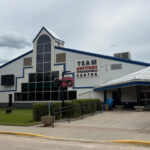
Donation leads to arena upgrades
Change is on the way to Drayton Valley’s arena.
The facility, which was rebranded as the Team Auctions Centre last year, will see upgrades valued at $1 million thanks to a contribution from an anonymous donor.
In the high and far-off times
Nothing in the last 50 years has quite matched the feeling I got waking up one July morning in 1976 and realizing I wouldn’t have to so much as think about simultaneous equations for the next six weeks.

E-dirtbikes raise safety concerns
Off-highway vehicles are not allowed on public municipal property in Drayton Valley, whether they are electric or not.
Fourteen days of steady rain
How do you spend a two week holiday when the weather is crappy? With visitors from Scotland in tow, my wife and I set out to find the answer to that question earlier this month.