Submitted by Ron Cameron
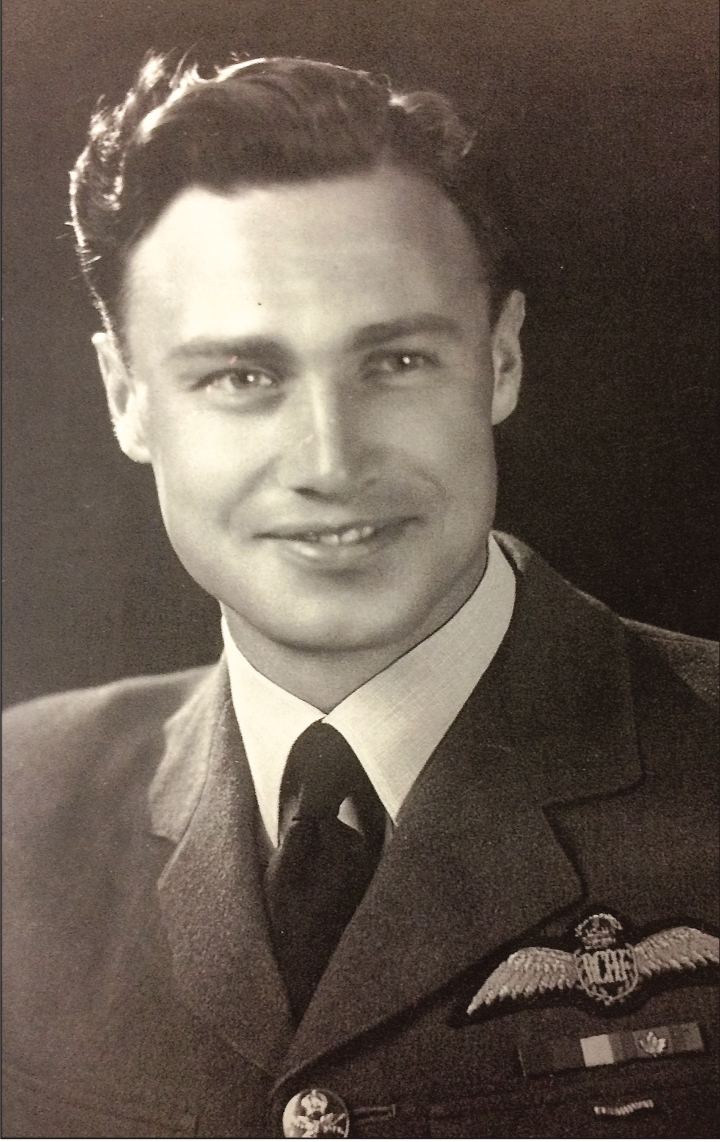
During WWII the Nazis built many Prisoner of War (POW) camps in Europe. Stalag Luft III was one of those camps, and it was built near Sagan, Poland. There are many terrific stories involvingCanadians in WWII. The Great Escape from Stalag Luft III is one of those stories, and the Drayton Valley area has a connection to it. Bill Cameron (my uncle), who grew up just west of Rocky Rapids, was one of 80 prisoners who, on March 24, 1944, escaped from Stalag Luft III.This escape is known as The Great Escape, and in 1964 a movie with that title was made in the U.S. The Hollywood celebrities who starred in the film were some of the biggest names of that era including Steve McQueen, James Garner, James Coburn, and Charles Bronson.
Like most WWI and WWII veterans, Uncle Bill did not talk much about WWII. So the story that follows is partly based on the few details that he shared with some of his siblings, and partly from a book by Ted Barris called “The Great Escape – A Canadian Story” (published in 2013). This is a terrific story and I highly recommend it.
Uncle Bill was a fighter pilot in WWII, and he flew Spitfire aircraft. In August of 1943 he was shot down over Tunisia and was captured by the Italians who handed him over to the Germans. Along with many other prisoners, he was stuffed into a railroad cattle car with no food, no water, and no bathroom facilities, and sent to Stalag Luft III. His family was notified by telegram that Bill had been shot down and was missing, and was presumed dead. It was six months before his family would get word that he was still alive. But shortly after his family got the good news that Bill was still alive, they got the bad news that Bill’s younger brother, Neil, had been killed in action in Italy. And just a few months after that they got the news that another brother, Dave, who was serving in the Canadian Army in France, had been shot in the stomach and was grievously wounded.
Stalag Luft III was divided into three different compounds which held a total of almost eleven thousand POWs, all of them being Allied air force personnel. Many of the POWs were determined to escape, and several different escape attempts were made. A British Air Force officer named Roger Bushell came up with the idea of digging a tunnel that would start inside one of the huts, go underneath the fence that surrounded the compound, and out into the forest that was just outside the fence. This evolved into the idea of digging three tunnels (each originating in a different hut), the reason being that the POWs believed it was highly likely that the Germans would find at least one of the tunnels, but they would never suspect that there were actually three tunnels being dug. This made it much more likely that at least one of the tunnels would be successful. There were only about six hundred airmen involved in the actual digging of the tunnels. The remaining POWs were not even aware that the tunnels were being dug. We do not know how it was that Uncle Bill became involved in the tunneling.
Opportunity Home’s first Spring Shaker was a success, says executive director Danna Cropley.
“The event sold out within the first few weeks,” says Cropley. “Beyond that, the event went absolutely amazingly.”
The evening had a dance, a catered dinner, and silent auction items to help raise funds for the rehabilitation centre. Cropley says it wouldn’t have been possible without the volunteers who helped put the event together. About 230 people attended.
“Jen Winter, Janice Kupsch, and their crew organized the event. The room was full of energy and community; it was so great,” says Cropley.
One of the reasons for the event, along with raising funds to help run the facility, was to educate the public about what the facility does and how it helps those in need. Opportunity Home opened its doors in February 2023, and has seen numerous people complete the 90-day program during its three years of operation.
Earlier in the week, Cropley also spoke to town council with the same goal in mind.
“Because the council is fairly new… we just wanted to update them on Opportunity Home’s mission, vision, and values, [as well] as the value our project brings, not only to the municipality but also our provincial community and out to our country.”
Cropley says the facility has offered beds to people from across the province, British Columbia, and some from the United States. She says she wanted council to see the reach that they have now and how they are supporting Recovery Alberta’s response to the current opioid crisis.
In her presentation to council, Cropley touched on the community, social, and economic value the centre brought to the community. This included the volunteer work the clients provided, homelessness and poverty prevention, as well as reducing taxpayer costs for emergency, health, and justice services.
She says community investment is a crucial part of the success of the centre, not in terms of dollars, but in terms of interest from the community, volunteers, and feedback.
“I just really wanted to make sure that town council was aware of who we are and what we do,” says Cropley.
Opportunity Home is hosting another event on June 19 from 11 a.m. to 2 p.m. that is open to the public: a memorial tree planting ceremony, along with a barbecue and tour of the facility. Cropley says they will also have different resources and services at the event for people to connect with if needed.
She says the tree-planting ceremony will be in honour of some community members who have recently passed away. Members of the public are welcome to donate to plant a tree in memory of someone they have lost.
It seems that those pushing for Alberta independence have enough signatures to force a referendum on the issue. That put me in mind of something I wrote a few years ago that I think still holds water.
If Alberta’s going to ditch the rest of Canada we need to set a few rules. This is going to take a while, so it’s best to start talking about it now so we know where we stand if and when it comes to a vote.
First we have to figure out what an Albertan actually is.
There used to be a guy who lived down the street from me who had a bumper sticker that said, “Canadian by birth, Albertan by the grace of God.” It always struck me as a little odd. That was partly because it was on the rear bumper of the first Toyota Prius I’d ever seen with a gun rack. But it’s also because I’ve lived in this province for well over three decades, and I’ve never been able to figure out what makes an Albertan an Albertan.
OK, so an Albertan is someone who comes from Alberta. That’s according to no less a source than the Oxford Canadian Dictionary so I’m not about to start arguing. But the results of the most recent federal census suggest that’s a pretty broad group. If the number and variety of languages spoken in this province is any kind of a guide, Albertans come from all over the place, both within Canada and from every corner of the globe.
That’s true of other places too of course. Places like London and New York are breathtaking in their diversity. What makes Alberta different is that everything here is so new. We’ve been a province for not much more than a century and have evolved so rapidly in such a short time, with so many waves of immigration from so many parts of the world that it sometimes feels as if we’ve never developed a separate sense of ourselves. At least not in the way you’d find among the societies of Africa, Asia or Europe, or even in Newfoundland, Nova Scotia or Quebec.
So what do we have that binds such a broad group together and sets us apart from the rest of the country? There’s the Flames and the Oilers I suppose. And beef. We like beef and are justifiably proud of both the quality and quantity this province produces. I think it’s also fair to say that we work hard. Not me, obviously, but most of the rest of you. And perhaps most importantly right now, there’s a sense of frustration that we always end up with a federal government that most of us didn’t vote for. But even at the last election, when dislike of Ottawa was probably at its peak, more than a third of us voted either Liberal or NDP and a significant number of us didn’t vote at all. So things are not as black and white as they may appear.
Anyway, as far as things that set us apart from the folks in Toronto or Tuktoyaktuk, that’s about it. Don’t get me wrong. I love this province and I love the people who live here (most of you anyway) but it doesn’t feel like we’ve got much to build a country on. Albertans are good people and we have a lot to offer the world. But at the same time we’re an odd and interesting mixture that doesn’t seem quite sure of its own identity. Sort of like a Prius with a gun rack.
The Eleanor Pickup Arts Centre will be hosting the Yellowhead Regional One-Act Plays Festival on April 10 and 11 this year.
Ashley Luckwell, the chair of the board for River Valley Players, says the regional festival will have five performances this year. Cast and crew from Leduc, St. Albert, Devon, Beaumont, and Drayton Valley will be participating in the event.
“There are five different groups from the Yellowhead Region that are coming,” she says.
Luckwell says the event is being put on by the Alberta Drama Festival Association (AFDA). This festival is one of several that are occurring across the province, with the winners from each heading on to the provincial festival in Leduc in May this year.
“We’re really excited to have it here,” says Luckwell. “It’s great to show off the EPAC; it’s great to have them come into our community.”
The festival will take place over two days, with each of the plays lasting anywhere from 30 minutes to about 45 minutes. RVP members Leah Sanderson, Sarah Chapman, Katherine De Varennes, and Jan Wright will be performing their play Overtones on Friday night.
Luckwell says the play is one she directed and was written by Alice Gerstenberg in the early 1900s. It was first performed in 1915 at the Bandox Theatre in New York.
The play highlights the difference between what people say and what they are actually thinking. Two of the actors will be playing characters having a conversation, and two younger actors will be playing a younger version of themselves giving voice to the first two character’s inner thoughts.
The other plays will be Steven Goes to Japan to Run a Marathon, Crystal Blue Persuasion, The Crimson Cab Ladies Hit the Beach, and Don’t Mention Hollywood.
Luckwell says there has been lots of support from local businesses for this event, with some giving discounts on food and others sponsoring the festival as well.
“It’s been really great,” she says.
Tickets for the event will be for sale at the doors for $15. Luckwell says cash is preferred as it is not the EPAC that will be taking the funds, but rather volunteers for the AFDA.
Add Your Heading Text Here
- HOURS: Mon–Fri: 8:30AM – 4:30 pm Sat - Sun: Closed
- CALL: 1-780-514-7359
- LOCATION: 5205 Power Center Blvd #108,Drayton Valley, AB T7A 0A5
Doomscrolling is a terrible habit for sure, and it’s one that I’m guilty of from time to time. It mostly depends on my mood, energy levels, and whether I have to sit and wait for an extended period of time.
The videos that have captured my imagination the last little while are the ones where content creators from other countries react to all things Canadian. That means everything from trying ketchup chips to seeing some of the worst ice storms the Maritimes have experienced.
Some of my favourites are the ones about wildlife. It’s entertaining to listen to the narrator speak about how big a moose is for fifteen seconds while they show a five-second clip of a moose, then five of an elk, and five more seconds of several white tail deer bounding into the distance. No one will ever know which one is the moose.
Another favourite of mine is videos of the Cobra Chicken, or for those of you who don’t speak to teenagers on a regular basis, the Canadian Goose.
The moniker Cobra Chicken is a little odd, but I guess it’s because they’re a big bird with long necks. Thus parts of them look like cobras and the rest looks like chickens.
In any case, anyone who has ever been near a goose in the spring knows they aren’t birds to be messed with. These birds can weigh up to 12 pounds and can reach speeds of 80 km/h on a normal day. With tailwinds, they can reach speeds of 112 km/h or higher.
Last April, a group of college students in Waterloo, Ontario, had to get creative with entering and exiting their house when a pair of geese decided their front yard was the best place for their nest. For several weeks they had to be very careful about when and how they entered their house because they could be attacked.
Of course, calls to any groups who could help with the situation were no help. The Canadian Goose is a protected species, so people aren’t allowed to touch them or their nests, cause injury, or kill the birds.
While the videos are always good for a laugh, people can get seriously injured. Many of the injuries happen as people try to run away from the birds, but a downstroke from a goose can hit like a fist and leave you with some nasty injuries.
I’m saying all of this because the season of the cobra chicken is coming soon. We do have some geese that feel this area is a good place to bring up their goslings. It’s a good time to tell kids that geese shouldn’t be messed with and to start paying attention when we’re walking near any ponds.
I would hate to be the main character in one of the YouTube videos people come across while doomscrolling. I feel like that would be far less entertaining for me, though I’m sure it would give others a good laugh.
Plans to build a replacement for Drayton Valley’s St. Anthony School took a step forward last week.
St. Thomas Aquinas Roman Catholic School Division (STAR Catholic) received planning funding from the Government of Alberta to support the future replacement of the school.
The Province will pay $50,000 in value-scoping funding. The school division says the funding will support early planning to ensure readiness for a potential new school build. That includes conducting an initial investigation to confirm project readiness, identify key priorities, and ensure essential planning components are in place.
“This is very encouraging news for our division and for the St. Anthony School community,” said STAR Catholic board chair Henry Effon. “This funding reflects the board’s continued commitment to advocating for our students and allows us to take an important step forward in preparing for a much-needed new school.”
The replacement of St. Anthony School is identified as the number one priority in the STAR Catholic capital plan. Superintendent Laurie Cardinal said the division was grateful for the support received from the province.
“This further strengthens the step in supporting the high-quality learning experience students in Drayton Valley already enjoy,” she said.
The current school dates back to the 1960s and has an enrolment of about 430. The building last had a major renovation in the 1990s.
As the POWs had suspected, the Germans did suspect that a tunnel was being dug, and they managed to find one of the three tunnels. That left the POWs to continue work on the other two tunnels, and it took about a year before one of them was completed in March, 1944. The POW’s wanted to wait until the weather warmed up a little before they attempted the escape, but they became worried that the Germans suspected that there might be another tunnel. So on the night of March 24, 1944, eighty airmen were able to escape through the tunnel and get outside the fence. Uncle Bill was the 62nd prisoner who got out. But as fate would have it, just as the last few prisoners emerged from the tunnel, a German guard caught them and sounded the alarm. So eighty prisoners got out of the tunnel, but only seventy six got away. Of that number, only three were able to get back behind Allied lines – the other seventy three were recaptured.
March of 1944 was unusually cold and the escapees did not have much in the way of clothing. Uncle Bill became hypothermic and was unable to keep on moving, so the other airmen that he was running with had to leave him behind. The Germans found him three days after the escape, and he did not try to put up any resistance when they caught him.
Hitler was livid when he was told that there had been an escape from Stalag Luft III, and he issued the Sagan Order which decreed that all of the escapees who were recaptured were to be shot. For some reason Air Marshal Hermann Goering protested the order, so it was amended to say that more than half of the escapees were to be shot. The Gestapo determined that the phrase “more than half” meant fifty, so Area Commander Arthur Nebe was given the job of deciding who would live and who would die. It is not known exactly how he made his choices, but it appears that he chose to execute those who did not have a family and were a little older (although none of the escapees were actually very old). Uncle Bill was only twenty three, so his relatively young age probably saved his life. Also, he thought that perhaps two other factors had saved him – he did not put up any resistance when he was captured, and, unlike some of those who were recaptured, he did not speak any German.
After WWII, Uncle Bill was shipped home to Canada where he got married and raised a family. He died in 2000 at the age of 80 years.

Those of us who have come after Uncle Bill’s generation have been able to live a life filled with freedom and opportunity, in large part due to the sacrifices that Uncle Bill and all the other veterans of WWI and WWII made. On Remembrance Day, let us pause to remember what they did for all of us.