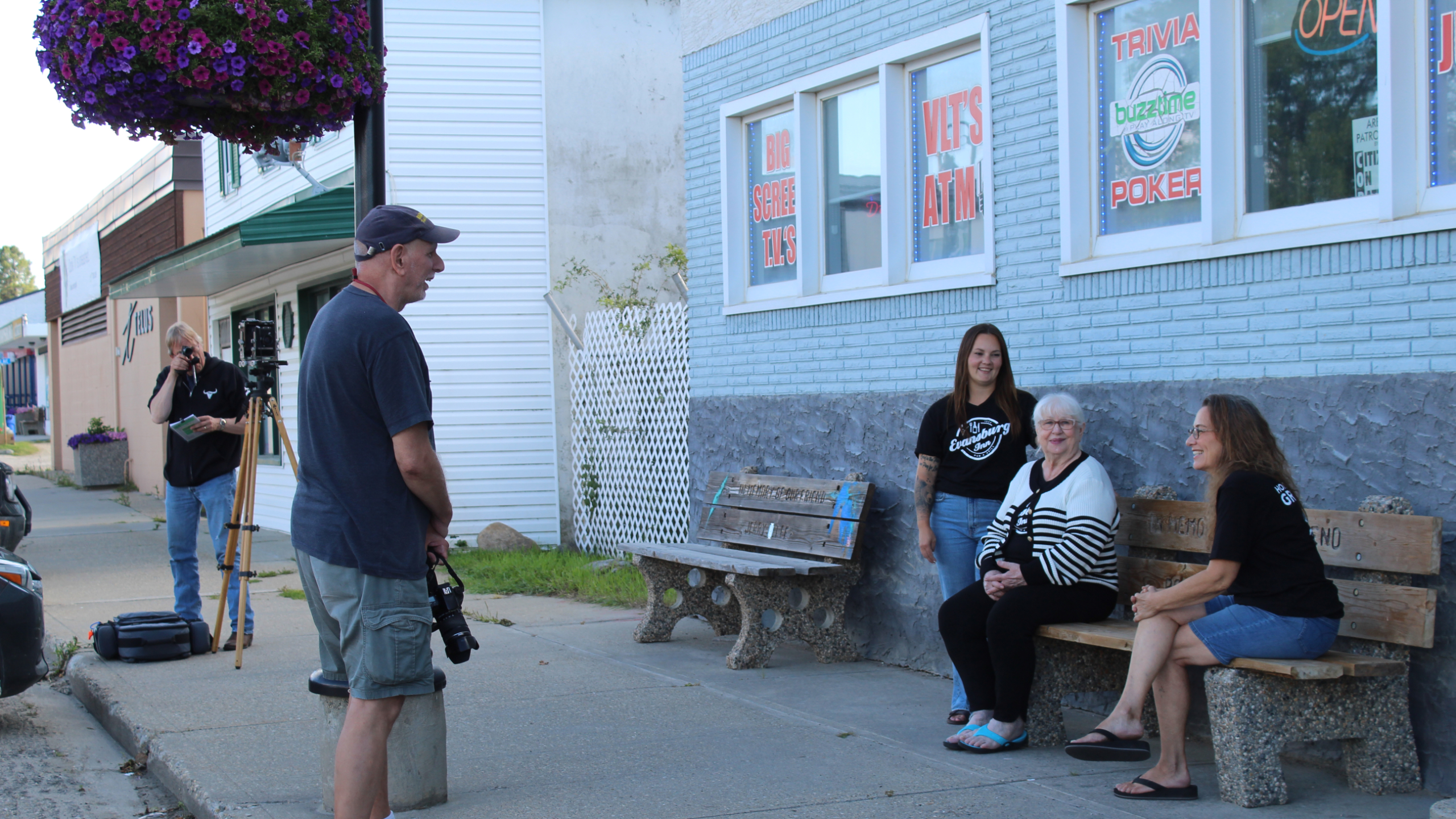
Last Friday the Evansburg Inn was entered into the annals of history by the Beer Parlour Project, which has been making a photographic documentary of historic hotels across Western Canada.
Chris Doering, Rob Pohl, and Doering’s wife Connie Biggart are the founders of the Beer Parlour Project, which aims to record the history of hotels that were the focal point of their community when they were first built. The group wants to capture the essence of the building using a combination of digital and vintage flash photography of the building and the community of people who use it.
“My friends and I are history photographers,” says Doering. “So we go around and document historic buildings, machinery, or whatever the case may be.”
While they were out in the field working, they were often in rural areas. Often there were hotels in the community, some of which were still original structures from the first half of the 20th century, and they would stop in for lunch.
“Right under our noses is all these really interesting hotels with really interesting stories,” says Doering.
The trio started the project in 2022 and have been to about 50 rural establishments since then. Their goal is to visit 100 older hotels across Western Canada so they can publish a coffee table book. They’ve already secured an exhibit at the Alberta Art Gallery in 2028, which they are excited about.
The Beer Parlour group started their weekend on a Thursday at the Colinton Hotel in Colinton, Alberta. From there they drove to Evansburg on Friday, and on Saturday they stopped in at the Warburg Hotel and Saloon.
Though Doering, Biggart, and Pohl all have full-time jobs, this project is their main hobby. The group is funding their project on their own, though they are looking for some arts grants to help cover some expenses. As such, they try to get as many stops in as possible if they have to travel any distance.
Doering says they pick areas to focus on each time they are planning to work on their project. Once they have the area and have selected the hotels, they look into the history of the building and its relationship to the community. They also consider the cultural side of things and how people are involved in the history of the building.
“They’re really little hidden gems,” says Doering. “Outside appearances can be deceiving.”
Doering’s role in the project is digital photography, research, and handling most of the interviews.
“You hear some really amazing stories,” says Doering. “Some hilarious, heart-breaking — you name it.”
Pohl focuses on taking photos, often on his vintage tri-pod camera, and he also helps with some of the writing for the website.
While Pohl’s camera isn’t the best camera for the project, he uses it because he prefers to develop the pictures in his darkroom. It also provides a great ice breaker as patrons come up and ask him questions about it.
“It’s funny, the expectations of people now, especially the younger generation. [They say] ‘Can I see the back of the camera? What does the picture look like?’” says Pohl.

He says people are often shocked that it will take a month for the picture to be developed, but they always offer to send them a complimentary picture when it’s ready.
Pohl says now that they’ve been to a few different bars, had their stories told in the paper, and have been interviewed for television and radio, they can show that they are credible and have a legitimate project that they are working on. This could make it easier to secure grants to help cover some expenses, and it could also make it easier for them to get their work published in a book.
It hasn’t always been easy for them to get people to trust them. For the most part, owners have allowed them to come in, take some photos, and talk to people; however, some have turned them away.
“There is always a little suspicion because they think we’re either gonna portray their place as a dump and try to make fun of it, which we’re not. We’re trying to celebrate it, get people aware of these [places] and out there to enjoy them,” says Pohl. “We don’t use any images or take any pictures in a way to portray it in that light, so we’ve got to get that understanding in place.”
The other suspicion owners sometimes have is that the Beer Parlour Project is going to charge them for the work they are doing, which has never been the case.
The owners of the Evansburg Inn, Christine and Diane Maskell, say they were happy to participate in the project because they believe it’s important for small towns to be recognized and supported.
“Some people don’t even go off of Highway 16, and when they go to these small communities, they’re amazed at what they can find in them,” says Christine.
Christine and her mother-in-law, Diane, have owned the Evansburg Inn for nearly 26 years, and it was only recently that Christine decided to close the bar down on Sundays. Prior to that, she had been working every single day to keep the place going while raising five kids.
The best memories Christine and Diane have are of the people they’ve met along the way. The history of their time running the bar is tied to their memories of their patrons and friends.
Currently, Christine, Diane, Christine’s daughter Lindsey, and her daughter-in-law, Jacey, run the place.
“We do get along really good, honest to God,” says Diane. “They say that mothers-in-law and daughters-in-law don’t get along, but we do.”
The family run business has seen its ups and downs. Their family lost a grandson, son, brother, and husband when Robbie Maskell passed away in 2022.
But still, the women have continued to serve their loyal customer base. Christine is a Jill-of-all- trades, but she doesn’t touch the electrical. She does, however, handle the maintenance for the rest of the building.

“If it’s broken, she’ll fix it,” says Diane.
Over the years, their bar has been known as a place of respect.
“I say, if you respect the place, then I’ll respect you,” says Christine.
In the time they’ve owned the place, there have only been a handful of fights.
Diane recalls a time when Christine had to step in to keep the peace one night.
“There was going to be a fight — this was a few years ago. There was a regular sitting at the bar, and [Christine] knew he was going to go after [another patron]. She jumped over the bar and grabbed him, and hung onto him like you wouldn’t believe,” says Diane.
The bar has become a memorial for some. A bench outside the Inn was placed there in Robbie’s honour, and inside, there is a column filled with messages for a loyal patron who passed away.
“He used to sit in that spot,” says Christine. “He did a lot of plumbing work and help for us over the years we were here, and he suddenly passed away.”
They held a memorial service for Jerry Lee, and his family asked if they could write messages on the wall. Christine pointed them to the area where Jerry always sat, and Jerry’s family and friends left messages for him there.
Several years later, those messages are still preserved, and Jerry is still remembered.
“He had some nieces and nephews that were five or six years old. They’re 18 now and they come in, and they so appreciate that we still have [the messages],” says Christine. “A couple of weeks ago his daughter came in, and she brought her daughter in and they were talking about it. It’s kind of nice.”
Pohl and Doering’s only regret with this project is that they didn’t start sooner. Many old hotels have been closing down in recent years.
“We’ve kind of missed the boat in a way. We should have started a decade sooner and we could’ve gotten a lot more, but we’re going to have no problem hitting 100,” he says.
The group is also really enjoying working on the project, and Pohl thinks they might push past 100 simply because they enjoy it.
More information about the Beer Parlour Project can be found at www.beerparlourproject.com.