
Help is available for farmers with unproductive areas of land.
Since 2016 Brazeau County has been working with Alternative Land Use Services on a program assisting farmers in preserving unfarmable areas of their land for wildlife. For example in areas where there are creeks, the County will work with farmers and put up fencing to prevent cattle from using the area.
“They’ll fence off creeks to prevent cattle from going into the creeks and that will help increase the water quality,” says Corbyn Pankonin, one of the organizers of the program in the County.
Nancy Chambers, another organizer of the program, says another example is areas where farmers have really wet land that can’t be used. She says they consider what other things can be done with that land, and sometimes those areas will be turned into wetland projects.
One of the perks of participating in the program is that through the ALUS program, the farmers will receive annual payments from ALUS Canada for the land that they are not able to use.
“We give them some money to make up for that lost revenue that they potentially may have been able to get from it,” says Nancy. Farmers can enroll up to 20 percent of their land into the program.
Pankonin says they also do a cost share on the labour and materials needed to create the wildlife space.
While the program has been available for five years, they feel like they’ve mostly started picking up in the last couple of years. Chambers attributes this to word of mouth about the benefits of the program.
“That’s kind of what’s really driving our program right now,” says Chambers.
Pankonin says they have created habitats for some endangered species, such as the little brown myotis bat. Another one they’ve worked on is a pollinator habitat as well. “If a farmer has a crop that they want to attract pollinators to… we help them plant shrubs and flowers that will attract the bees and the moths and the birds that will help with pollination,” says Chambers.
Those who are interested in participating in the program can just give the County a call. However, Chambers says this program is geared toward farmers, not acreage owners. “The farmer has to have farm tax status. They have to have the potential to earn at least $10,000 in revenue based off of their farm.”
She says it’s important that potential applicants remember that it is only on marginalized or endangered land areas as well.
Pankonin says the reason for the cap on the amount of land that farmers can enroll is that the County doesn’t want to take too much land away from agricultural production.
Duane Movald is one of the farmers in the county that took advantage of the program.
Movald says he’d heard about the program from others. “I was aware of the premise behind it, to provide ecosystem services, for the greater good of society, not just the local area,” he says.
He says the broad scope of the project was what intrigued him the most.
For Movald’s land, they did a riparian fencing system along a creek that was on his land. He says they had fencing on one side that was about thirty years old, but they were always repairing or replacing bits of it.
“We ended up putting in a proposal for a permanent fence there as well as for the other side,” he says.
He says it limits the cattle movement in the area. The cattle can still be put in the area to keep the grass down when the area is hard and dry.
Movald says the project has evolved into a beautiful natural space. He says there are saskatoon and hazelnut trees now growing in the area, which also helps to keep the banks of the creek more stabilized. “You just kind of give Mother Nature a chance, and you see what she does,” he says.
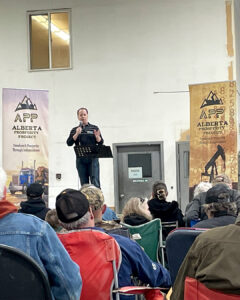
They’ve also held a riparian workshop in the area. Movald said part of the workshop was practical, so the thirty people that showed up went down to look at the land beside the creek. He says they thought it was so beautiful that he should put walking trails down there.
“Once you get in there, you hear the water running, it’s just beautiful,” he says.