
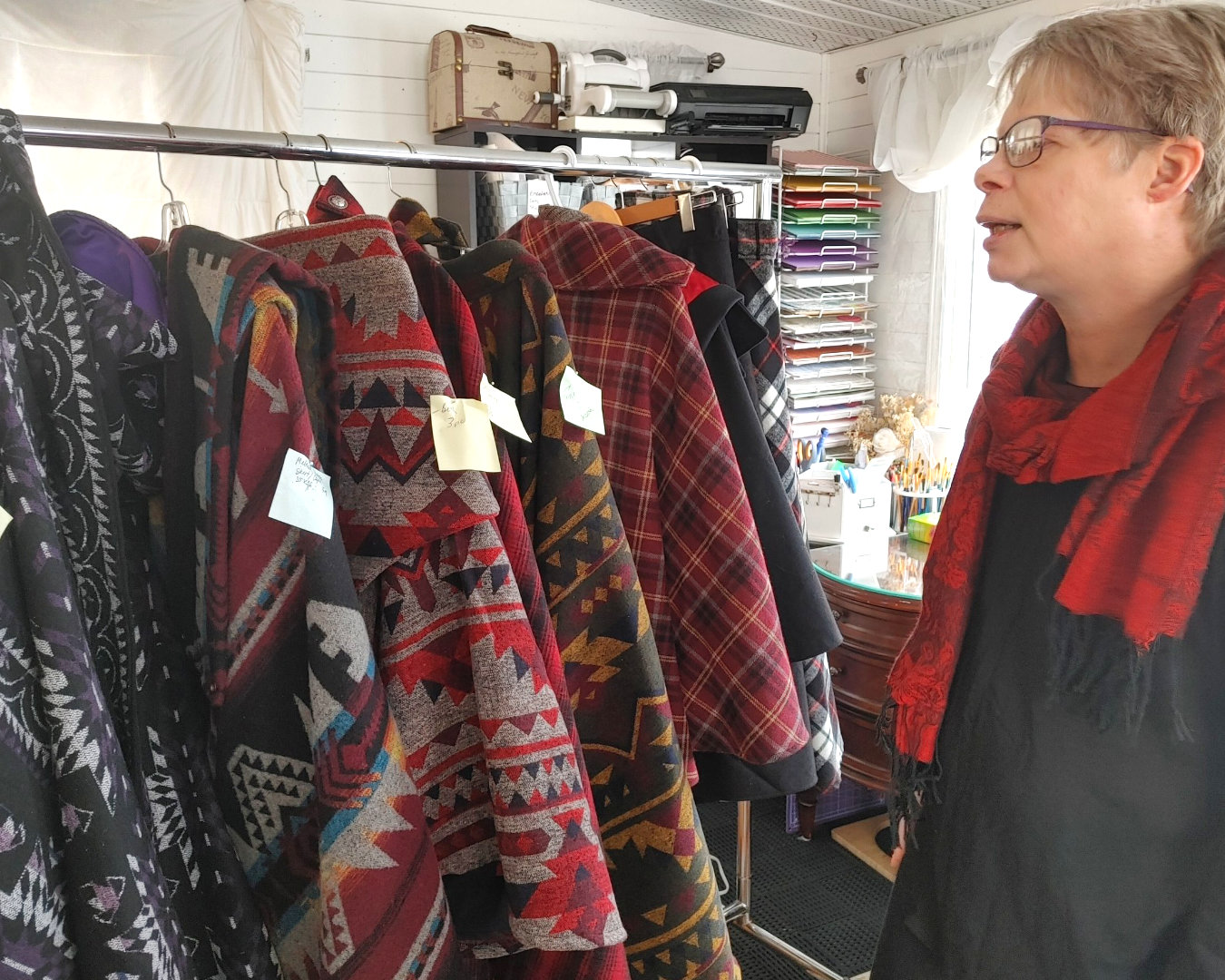

Inspiring perseverance are words that can be used to describe Drayton resident Deb Bossert. She has faced obstacles like cancer and immune disorders to start a successful second business in her retirement.
Bossert grew up in Vernon, B.C., but has been part of Drayton this community since 1996. Over the years she has volunteered in many different areas, all with the mission of serving others. Some may recognize her name from her time on town council, others in the faith community will know her from various events she’s participated in. During her time on council she served on many different boards. Bossert was also a volunteer with Humans Helping Humans and currently sits on the board of Burden Bearers.
On top of that Bossert was also a business owner in Drayton Valley. The store Designs By Deb was a bridal boutique that she built from the ground up.
“I’ve been sewing since I was a young girl,” says Bossert, which she says is 45 years of sewing. She is the fourth generation seamstress in her family, and her oldest daughter is the fifth.

Church of God
Drayton Valley Church of God. Our Worship Services usually include: traditional hymns, praise choruses, and contemporary songs, prayer, scripture, and a sermon.

Drayton Valley Alliance Church
Join us Sunday Mornings 10:30 am Everyone Welcome! Phone: 780-542-6501 Email: office@dvalliance.ca Mailing address: Box

Valley Worship Assembly
Please take your time and discover what is happening at Valley Worship in Drayton Valley.

Drayton Valley Community Church
DV Community Church. Located at Affinity Funeral Services, officiated by Dwayne Henley.
Dr. Chris Birchall Dentistry
Dr. Birchall Dentistry in Drayton Valley, Alberta. A dentist in Drayton Valley, Alberta.

However, life has not been smooth sailing for Bossert. About a year after her youngest daughter was born, Bossert separated from her husband and became a single mother. During that time she sometimes worked a full-time job, but she kept Designs by Deb running.
Designs By Deb was more than just a store for bridal wear. Bossert also offered sewing classes, altered clothing, and spent a fair amount of time repairing coveralls.
In 2009, after hearing encouragement from friends and community members, Bossert decided to run in a by-election for council. She went on to serve as a councillor until 2017.
In 2010, Bossert was diagnosed with aggressive bilateral breast cancer, which led to a double mastectomy as soon as the doctors could arrange it. Four years later, Bossert was diagnosed with a rare immune disorder called common variable immune deficiency.
“I didn’t expect to see 50,” she says and she’s grateful for the eight years she’s had since her diagnosis. “To have survived long enough to meet my grandchildren, and be involved in their lives, and to see where life has taken me has been amazing.”
She did not seek re-election in the municipal elections in 2017. She still worked as much as she could, though she was limited because of her health. However, she lost her job as a teacher for English as Second Language in 2020 when the pandemic hit.
“My health did take quite a decline that spring as well. I was told by my doctors that I needed to retire and just stay home,” says Bossert.
Bossert rarely goes out because her body does not produce antibodies and she has to take an immunoglobulin infusion to keep herself healthy and alive. Any illness she catches could result in hospitalization or death.
I suggested to my daughter that she name her first child Grahamina if it’s a girl. I haven’t managed to come up with a good boy’s name yet.
Here in Alberta, Noah is once again the most popular name for newborn boys, according to info that winged its way into my inbox a couple of weeks ago from the nice people at Service Alberta. On the girls’ side Olivia took the top spot in 2025, as she has done for the last several years.
It’s an interesting phenomenon* that kids’ names seem to drift in and out of fashion, like long hair, flared jeans and the federal New Democrats. Some of that is probably due to the impact of celebrities. It should surprise nobody if we see an uptick in Taylors due to the global dominance of Taylor Swift, while recent events mean the popularity of Andrew is likely to fall off a cliff.**
Looking back at my elementary school class, we had a couple of Davids, a Stephen, an Allan… on the girls’ side there was Jennifer, June, Dorothy and Elspeth. There was also a cluster of more overtly Scottish names: Alastair, Fraser, Morag and several Fionas. Little did any of them dream that more than 50 years later they’d be name checked in the Drayton Valley and District Free Press. What a strange world we live in.
Anyway, there were certainly no Noahs, apart from that guy with the boat from the Bible, who was not in my class (I’m old but not that old) so doesn’t really count. I don’t remember any Olivias either, although back then girls were both terrifying and mysterious to me, so who knows.
What I can tell you is that you couldn’t swing a cat in 1960s Glasgow without hitting a Graham.*** At one point there were three of us in my elementary class. Since I moved to Canada I believe I’ve only met one. ****
Meanwhile here in present day Alberta the rest of the top six boys’ names for last year were Theodore, Oliver, Henry, Jack and Lucas. Amelia, Emma, Sophia, Charlotte, and Violet round out the girls’ side.
There were more than 52,000 little bundles of joy registered in this province in 2025, with 14,500 unique names. That sounds like a lot, but presumably some are close to duplicates, so Brandy, Brandi and Brandee counts three times, which doesn’t seem fair really.
Anyway, it doesn’t look like there were any Grahaminas, and my daughter didn’t appear to be particularly taken with the suggestion. So if anyone out there is looking for a unique name for their newborn, Grahamina is there for the taking. You can thank me later. Although I suspect your daughter may not be so grateful
* Disclaimer: Phenomenon may not actually be interesting.
** That’s cliff as in geographical feature, not Cliff as in Clifford. Writing is hard.
***This was before the European Union stepped in and banned cat swinging across the continent.
**** I mean one Graham. I’ve met lots of cats. That’s cats as in Tom Kitten, not cats as in Cat Stevens. I’ve never met him.
After hearing the concerns of teachers and parents during the teachers’ strike last October, the provincial government has assigned their first phase of complexity teams to schools across the province.
“The classroom complexity [teams are] the Alberta Government’s response .. (to) the labour action,” says Jodie Mattia, the superintendent of Wild Rose School Division. “Classroom complexity was one of those pieces.”
Last fall, the province began collecting data surrounding the issue. The final report was released on November 21. The list of school divisions that have been assigned complexity teams was released on February 12. Teams consisting of one teacher and two educational assistants (EAs) are being sent to 476 schools with K-6 students.
“If there are additional dollars, those can be used for therapeutic supports,” says Mattia. She says the Province gave the divisions a list of supports that can be selected from in these cases, which may include speech therapists, occupational therapists, among others.
The divisions will have to send in quarterly reports to the Province, but Mattia says at this point she doesn’t know if those teams will be offering pull-out supports or inclusive supports for the students.
WRSD was assigned one team, which will be working at Rocky Christian School in Rocky Mountain House. The St. Thomas Aquinas Roman Catholic School Division was assigned two teams, which will be placed at Sacred Heart School in Wetaskiwin and St. Augustine School in Ponoka.
At this point, no teams have been assigned to any schools in this area. More than 75 percent of the teams were assigned to urban centres like Edmonton, Calgary, Lethbridge, Medicine Hat, Grande Prairie, and Fort McMurray.
Schools with K-6 students in Drayton Valley, Breton, Entwistle, Evansburg, and Tomahawk do not have complexity teams assigned to them at the time of publication.
Mattia says the divisions didn’t have any say in where the teams were originally assigned. However, the Province has allowed the divisions to submit a change request by February 20. Whether those changes will be accepted remains to be seen.
“In our school division, every single one of our schools has complexity,” says Mattia. “It’s throughout the division; it’s at all grade levels.”
She says as a division, they continue to tackle complexity through their staffing, support teams, and divisional support.
“It’s not like we don’t have speech-language assistants, speech-language pathologists, occupational therapists. [The complexity teams are] additional support,” she says.
In some ways, the complexity team at Rocky Christian School may allow the division to allocate some funds to other schools, says Mattia. With extra support for that school from the Province, they may be able to save a little bit of money on additional supports they might have had to provide for the school.
Mattia says they have already received the funding for the teams, but one of the issues is finding the staff to comprise those teams. “Staffing, recruitment, and retention is a significant challenge for rural education,” she says.
She says the division has positions that have been open since the fall, and they are aware it may not be easy to hire staff for the team. Recruitment and retention of teachers in the rural areas of the province has been an ongoing challenge for many years.
Though this first phase has seen most of the supports going toward urban centres, Mattia says they are hopeful there will be more available for rural communities in the future. In the meantime, she says the division offers great supports for their students and families.
“The divisional team and our school teams, they really do phenomenal work with our students and for our families,” says Mattia. “We’re going to continue to support, in our best possible way, student success. That won’t change.”
The Free Press reached out to the STAR Catholic School Division, but did not receive a response before the publication deadline.
Symposium puts focus on mental health
One of Canada’s most sought-after rodeo announcers and motivational speakers returned to his hometown last weekend as the keynote speaker at the Mental Health Awareness Symposium.
Brett Gardiner was born and raised near Drayton Valley and has a grad photo hanging on the walls of Frank Maddock High School. Last weekend, he returned to FMHS to share his own mental health journey and different strategies people can use if they are facing similar struggles.
Elaine Tamboline, the past president of the Drayton Valley Rotary Club, says picking Gardiner for the role of keynote speaker was an easy one. As the most awarded announcer in Canadian history, Gardiner has won Pro Rodeo Announcer of the Year 14 times, she says. He has announced at the Canadian Finals Rodeo, the Calgary Stampede, and since 2016 has been a regular on TSN’s series for the Professional Bull Riding Canada Cup.
Along with his awards in announcing, Gardiner holds a master’s degree in counselling and psychology, and has worked with professional athletes, educators, and large business organizations.
But his local connection also recommended him for the event.
“I think that’s how it started. Some of us knew his mother,” says Tamboline.
The symposium took place on February 21 and was hosted by the Drayton Valley Rotary Club in partnership with the Healthy Communities Coalition. The all-day event had 13 breakout sessions for attendees, two of which were hosted by Gardiner.
“Mental health is such a huge umbrella,” says Tamboline.
The symposium tackled some major topics, such as Canada’s Red Flag Law, understanding legal protections for survivors of domestic violence, Men’s Shed, recognizing and preventing sexual exploitation in youth, and
To make the free event even more accessible for residents, Brighter Futures provided childcare so parents could attend the sessions.
Tamboline says the decision to host the event came from a community needs assessment conducted by the Rotary Club.
“[We wanted to] determine what issues people were most concerned about in our town,” says Tamboline. “That took ten months.”
She says they spoke one-on-one with individuals whose demographics varied from homeless people, business professionals, single parents, seniors, and more.
“Their concerns were many, and they fell under the umbrella of mental health,” she says. “This is not surprising or unique because it has become a topic across Canada and around the world.”
The Rotary Club is most well known for its work on eradicating polio. With 1.2 million members in more than 32,000 clubs in 200 countries, Tamboline says they have many other mandates. Some apply to certain areas, some to certain communities, as well as worldwide concerns. At their last international convention in Singapore, with 20,000 attendees, mental health was a hot topic.
Tamboline says after their needs assessment, the Rotary Club partnered with the HCC to come up with strategies to help connect people in need to professional resources in the community. The symposium was their solution.
The Rotary Club hopes to make the symposium an annual event that can reverberate throughout the community. Tamboline says they will be watching to see how it has affected the community and if they have achieved any of the outcomes they were hoping for.
Tamboline says the organizers are grateful to all the organizations that came together to make the symposium a reality.
“[We have] gratitude and appreciation for the generous support and donations, and volunteers who believed this is important.”
Shared history is a foundation for the future
Last year we sent our daughter to summer camp, at the request of one of her friends. A text to my husband revealed that this was the summer camp he went to as a kid, as well as his mom and his grandmother. A deeper search showed that his great-grandfather helped build the camp back in 1945. Upon hearing this R- felt such a sense of pride and connection to a whole host of family whom she never met, and have long been dead.
Family history is often reduced to a series of names, birthdates and death dates. This is a great place to start but the real connection happens when you manage to find a snippet of information or a piece of family lore that gives one of those names a personality. For me this journey began with my Auntie Gwen and her book “The Keystone Legacy.” Writing through the voice of my uncle Mark, they recorded the day to day lives of early black settlers living in Keystone (Breton); clearing land, building tar paper shacks, cold winters, and going to school and church. To anyone living in that time the book would have been a snore. But, the book was published in 1997, 90 years after the first settler moved to the area and guess what happened! More time passed.
As decades wore on and storytellers died, the value of this book increased. What used to be just a collection of stories and recollections has now become a primary source document for other books and a very cherished piece of family history.
This week I had the privilege of sharing a bit about my family history at the Drayton Valley Multi Cultural Association’s first black heritage event. As I walked into the room and saw African art lining the walls, vibrant clothing for sale and heard personal stories from those first generation Canadians in attendance, I had a sudden flash of imposter syndrome. Here are people who are so close to their immigration story that my historical stories about slavery, segregation, and land politics seemed old news, and out of touch.
However, in the scope of history even a century doesn’t seem that long. As I was talking to this group about my story I was inspired to press on them how much their story will mean to their future family. Documenting why you came to Canada, and what early life was like doesn’t seem like much right now but to someone six or seven generations later, it may be just the piece of information they needed to hear to feel that they belong.
Throughout my genealogy journey I have been lucky to have found shreds of newspaper clippings, land allotment interviews, references to my family in the books, “The Keystone Legacy,” “The Ghost of Crook County,” and “The Black Prairie Archives,” and of course the endless source of information and connection of Allan Goddard and the Breton Historical Society. Some may not be as lucky, but as is the case with my daughter, when her great-grandpa built a camp in 1945 he unintentionally built a bridge to future generations.
Working youth are suffering
Not too long ago, I heard a complaint about youth being too lazy to get jobs nowadays. That annoys me to no end because not only is it painting an entire generation with a broad brush, the blame for lower employment rates is placed solely at the feet of the youth, which is not right.

I started working when I was about 15 years old. At that point, my starting wage was about $6.95, and getting a ten cent an hour raise was awesome.
I didn’t struggle to find a job. I basically dropped off my resume to several businesses, went for the first interview, and got hired. While I may not have appreciated the job, I never worried about what my work schedule was, if they were paying me what I was owed, or if they were meeting labour laws.
My parents also didn’t really have to worry about it.
However, my first experience of seeing the abuse (I don’t use this term lightly) of a youth at a job was as an adult, around my mid-20s. At that point, I’d worked enough jobs to understand shady behaviour when I saw it, so it really bothered me to see employers taking advantage of young workers.
Fast forward to about five or six years ago, and things have only gotten worse.
The common misconception that youth just don’t want to work anymore fails to take into consideration the work environment we insist they join. Not only are there fewer jobs available for youth, but many employers are far more interested in making money than introducing youth into the workforce.
For those who have been lucky enough to find jobs, I have heard about some awful, and frankly, downright illegal things taking place.
In one case, a pizza delivery driver who was paid per delivery and tips was expected to be at the workplace for an entire eight-hour shift without getting paid. If there were only two deliveries that night, their base pay for the entire shift was a whopping $7.
Another situation I’ve heard about is a youth who was hired to work at a new business in the community. They were brought in with numerous other youths in the community for mass orientation sessions. Half of the kids who showed up, having been told they were hired, were turned away at the door or never actually got to work for the company.
This same company would change the shifts for kids with barely 24-hours notice, didn’t fill out any paperwork for their new staff, and made false promises of rewards for teams who worked the hardest.
Once that company decided who they wanted to keep around, they let go of some employees, who were mostly in high school, by text message on a school day.
Yes. A business that has a name that everyone would recognize fired kids by text message while they were at school. Illegal? No. Unethical? Absolutely; not to mention cowardly and callous.
Imagine how these kids felt learning they’d been fired from their first job, with zero explanation, while they were sitting in class at school. I’m sure they were eager to go out and find another job after that.
Other stories include bringing in a youth to try out for the job for a day without pay, and then ghosting them afterward; convoluted pay structures and bonuses that make it difficult for employees to know if they were being paid appropriately; and sending them out to do dangerous work without the appropriate training.
The moral of this story? Before business owners want to complain about the apathetic youth of today, they need to recognize that their attitudes and practices might just be the reason for this problem.
Drayton to host U11 finals
The Team Auctions Centre will be a busy place in March as it hosts the U11 A and B teams Division Finals on two different weekends.
Kara Westerlund, a member of the social committee for the event, says this community was selected after the Drayton Valley Minor Hockey Association put in a bid with Hockey Alberta.

“We came out on top,” says Westerlund. “I’ve been involved in hockey for a while; this is the first time we’ve ever been successful … so it’s quite exciting.”
DVMHA is expecting up to nine teams for the finals. Two of those teams will be from Drayton, as the host team always gets a spot, even if they aren’t in the top spot to make the finals.
“The neat thing is that both the A and the B team are at the top of their league right now, but that could change in a heartbeat with the games that are remaining,” says Westerlund.
The first weekend, March 7 and 8, will be the finals for the B teams, and the second weekend, March 14 and 15, will be for the A team.
Putting on the event will take the work of many volunteers, says Westerlund. She says they will need people to organize volunteers, to put together the player bags, cover the clocks for the games, score keep, play the music, man the penalty boxes, and more to keep everything running smoothly.
Some local businesses have also stepped up to help out with the finals, says Westerlund, with one providing all the hockey pucks for the event.
“Outside of the hockey… it’s so cool for our community to be picked to host something like this,” says Westerlund. “There’s potentially up to nine teams that are going to be in town, and there’s an average of 16 to 18 kids on a team.”
Westerlund says they already know they are going to fill up at least one hotel, with a high likelihood of filling two or more for both weekends in March.
“When they come, they bring their families and they have to eat, so the whole hospitality side and service industry in Drayton is going to see a massive boost that weekend for sure,” she says.
Ryan Fynn, the president of the Drayton Valley Hospitality and Tourism Authority, says these types of events are always great for the community.
He says with 150 hotel rooms being booked for two nights, the food, the fuel, and possible shopping, the economic impact will be around $200,000 put back into the community.
“Any time these finals come to Drayton, it’s always been how can we help them the best,” he says. “The biggest thing is highlighting the community and making these teams want to come back to Drayton.”
Fynn says the DVHTA has always supported minor hockey with sponsorship funds, marketing opportunities, or items for the players’ bags.
“It definitely falls right in line with what we’re all about,” he says. “We’re excited that they were awarded the bid from Hockey Alberta and glad they’re able to follow through with it.”
Westerlund says aside from the economic benefits of these events, there’s something that’s even more important.
“All the work is worth it; it’s for the kids at the end of the day,” says Westerlund. “We all know, even as adults, that moments like this and weekends like this are memorable for the rest of their lives. They will remember this.”
She says they want to make sure the event is special for the kids and shows off the community.
“I don’t like to dwell on the limitations of my medical condition. I’ve learned to be very content and very happy at home,” she says.
When the pandemic broke out, Bossert hardly left the house. Determined not to give in to the loneliness and depression that can come with long-term self-isolation, Bossert turned to painting and calligraphy as an outlet.
Bossert says in many ways she’s reinvented herself over the years. “From administrator to town councillor to teacher and to script and copy editor and calligrapher and artist, and now I’ve come back to my sewing.”
She says she was surprised to realize she had any talent as an artist, because she had never done it efore. By selling the water colour cards she was making, Bossert was able to bring in a little money, but nothing major.
It wasn’t until one of her friends, who became a partner in her new business venture, requested a favour from Bossert that she was able to bring in full-time income.
In mid-October 2021, Bossert’s friend came to her with a request for a riding skirt. Her friend had one, but wanted another, and Bossert was happy to help. She first made a prototype to ensure she got it right, and then she built her friend’s skirt.
At the Home Expo at the MacKenzie Centre in late November, Bossert displayed the skirts she had made. From there her business has exploded.
“It just went crazy from there. Within the first month we had 26 orders,” says Bossert.
Since December, when Bossert first started pursuing this new niche market of historical equestrian wear, she has had almost 60 orders. These have been delivered to 14 states in America, and one was purchased by someone from Switzerland via a sibling in Canada.
“Only about ten percent of my clients are from Alberta,” she says.
She says word has spread through social media, and she hasn’t had to do any advertising. If she posts a picture of a new product, she says she gets even more orders. To allow her to catch up, Bossert says she’s been radio silent on social media for a couple of weeks.
“As soon as I launch stuff, then boom, I get even more orders,” says Bossert.
While the business is a success, it’s been a lot of work in a short period of time. After 30 years, she has decided to retire Designs By Deb, and has now rebranded her business as The Creative Daughter. This has meant ordering new signs, creating a logo, new labels for her products, and finding the space to make it all happen.
Close observers of current events, or anyone with a pulse for that matter, has probably noticed that the world is a pretty crappy place right now. How crappy? Well, it’s as crappy as it’s ever been as far as I can remember, and I’ve been around since the Dead Sea was just sick. It’s got to the point where I dread checking the news every morning for fear of whatever fresh atrocity has emerged overnight.
But we’re not going to talk about that this week. It’s almost Valentine’s Day, so let’s talk about love.
I love people. Not all of them obviously. There are one or two out there who I wouldn’t cross the street to pee on if they were on fire. But I was thinking the other day that there are a surprising number of people, here in Drayton Valley and in other places too, who in one way or another make my life better. Some of them do it on purpose. Some of them do it by accident. And some of them do it simply by existing. But I’m grateful for each and every one of them.
I love sitting outside on my deck on the first real spring day and watching as six months worth of dog poo gradually appears through the snow on my neighbour’s lawn. Other people’s problems are the best kind of problems.
And I do love the sunshine we get here. I grew up in Glasgow, where we were taught to believe that any sunny day might be the last we’d see for a generation, so you learned to appreciate a bit of blue sky when you saw it.
I love salty snacks. They are so darned tasty. Sadly, it’s become increasingly obvious over the last few years that those same delicious treats are trying to kill me. But unrequited love is still love.
I love my job. Or I do some of the time. Sure there are days when it’s a pain and I really don’t feel like dealing with another story about sewers or snow removal. But those days aren’t that common and I’m privileged to be able to do something that for the most part I enjoy. And I’m also lucky to work with people who I rather like. Don’t tell them. They must never know.
I love Canada. This year marks four decades since I made this country my home. I imagine there’ll be a parade of some kind on May 19 to mark the anniversary. This is a great place to be. Sure we’ve got some problems – winter’s aren’t great, food has become too expansive and apparently Justin Bieber has a new record coming out – but this is still one of the best, perhaps the very best, countries in the world by pretty much any measure. Shut up Sweden, nobody’s talking to you.
I love that this is a long weekend, which is exactly 1.5 times better than a regular weekend. Yes, observant readers might notice I have used that joke before, but that doesn’t make it any less true.
And I love how easy it was to come up with this list. The world is a grim place right now, so I consider myself lucky to be able to say that here at home things are not too bad really. I hope you’re able to do the same.
After a wait of several months, residents at the Wishing Well once again have a working elevator.
Since October last year the elevator has been out of commission while the province waited on parts for the repair. Brazeau Foundation CAO Denise Chesterman says some of the parts were coming from the United States, which only added to the wait time.
However, once they reported to the Province that the elevator wasn’t working, they were given approval right away to start the process. Chesterman says she was grateful for how well the Province worked with them to ensure it was taken care of as quickly as possible.
Though the elevators weren’t working, the staff at the Wishing Well and the Shangri-La Lodge were doing what they could to accommodate or help those who would typically need the elevators. They even went so far as to install a washer and dryer on the second floor to help residents easily access laundry services.
Once the parts came in and the elevator was repaired, the Alberta Elevating Devices and Amusement Rides Safety Association inspected the repair to ensure it was safe for use.
Chesterman says the Wishing Well’s elevator isn’t the first thing the Brazeau Foundation has had issues with. She says about ten years ago, one of the elevators in the Shangri-La Lodge had to be repaired, and while it wasn’t down for as long, it was not a quick fix, either.
Sylvia Angus-McConnell, the housing manager for the Wishing Well, says she’s been receiving a lot of comments from the residents, and they are all happy they can use it again.
Every building run by the Brazeau Foundation is owned by the Province, and the care and maintenance of the elevators has always fallen under provincial responsibility. However, Chesterman and Jeannette Vatter, a board member for the Brazeau Foundation, say the province has always been great about ensuring the elevators are inspected, kept in good condition, and repaired as quickly as possible if there is an issue.
Let’s start this week with a cautionary tale.
A long, long time ago there was a push to build a fieldhouse in Drayton Valley. It began as an idea to create a dedicated space for indoor soccer. That sounded just dandy. Then some other folks got involved and they added all sorts of stuff to the proposal, so the facility was going to include everything from athletics to archery. And then someone came up with the idea to add a banquet hall too, because why not?
The proposed multi-purpose fieldhouse began to look a lot like one of those tools they used to sell on late night television. You know, the kind of thing that’s a hammer, and a screwdriver and a spirit level and a wrench all built into one. The trouble with that kind of gadget is that it’s usually not a terribly good hammer or wrench or whatever, because it’s trying to do too much. So while trying to please everybody, the fieldhouse project collapsed under the weight of its own good intentions. Municipal staff had put a lot of effort into trying to make it happen. Volunteer groups had worked hard to raise money. So when the fieldhouse hit the skids the debacle left a bad taste in a lot of mouths. The only part of the project that came to fruition was the banquet hall, which evolved into the MacKenzie Conference Centre. The MacKenzie Centre is great, but you can’t play soccer in it. Well, you probably could, but it wouldn’t be a very good idea.
I mention this because I, along with everyone else in Drayton Valley and Brazeau County, am being asked for my opinion on the future of recreation in the community. In case you missed it, there’s a survey on the Town of Drayton Valley website.
I took that survey so you don’t have to.
Perhaps I’m not really the target audience. They start by asking which facilities you use. I’m not much of a swimmer – more of a sinker really – so I have used the new pool precisely twice since it opened. Mind you, that’s a dramatic increase from the old pool, which I used once in 20 years.
Skatepark? Nope. Outdoor rink? Nope. Soccer fields? Nope. Omniplex? I’ve popped in to use the washrooms a couple of times. Does that count?
As far as other facilities are concerned, I have been to Whitby Hall quite a lot. I even got married there once. But those visits, plus a couple to Easyford, have almost all been for weddings or funerals. Does that count as recreation? I suppose there’s dancing at some of them.
Anyway, in spite of the fact I don’t use those facilities, I can see the value of having them in Drayton valley/Brazeau. Good recreational opportunities add to the quality of life and they make the entire community a more attractive place to live and work. Just because my own preferred form of recreation is sitting on my deck drinking beer, doesn’t mean it’s that way for everyone.
Next on the survey was a page asking what kind of facilities I’d like to see in the future. There, right about the middle, was an option for a fieldhouse. My first thought was, are we really going to go there again? But my second thought was, why not?
The survey makes it quite clear that the list of possible future facilities are just ideas, and that each one would come at a cost. A fieldhouse would be a very expensive option and would take years to come to fruition.
But it’s something to think about, and I think there’s a conversation worth having.
It’s been close to 20 years since the proposed multi-purpose fieldhouse died on the drawing board. A lot of things have changed since then. Maybe it’s time to try again.
Due to a gap between provincial funding and actual transportation costs, the Wild Rose School Division will be charging busing fees for students beginning in the 2026/27 school year.
In a statement to the parents, WRSD superintendent Jodie Mattia explained that rising costs for transportation are the reason for the new fees. Since 2019, the division has been using contracted operators for busing to reduce costs associated with maintenance and replacement. Beginning in the 2024/25 school year, the division has been unable to stretch the grant funds from the province to cover all expenses.
“… bus contractors are experiencing rising costs in maintaining and updating the bus fleet, fuel and insurance,” says Mattia in her statement.
The decision on the fees was made at the January 20 board meeting.
“This is our second year in a row with a million dollars in deficit for transportation,” says WRSD board chair Daryl Scott.
The fees that parents will have to pay will depend on how far they are from the school their child is attending. Scott says students are divided into two categories for busing: eligible and ineligible, and the rate they pay depends where the students fall.
Eligible students are K-6 students who live more than 1.6 km from their school and 7-12 students who live more than 2 km from their school. The busing fees for these students will be $300.
Ineligible students are K-6 students who live less than 1.6 km from their school and 7-12 students who live less than 2 km from their school. The busing fees for these students will be $600.
The fee will be applied to every child using WRSD transportation services, with families getting a discounted rate when they have three or more children using the busing system.
Scott says the transportation funds they receive from the Province are separate from the funds they give for the students’ education. During the first year of deficit, the division used funds from their transportation reserve to cover the gap.
Rather than implementing these fees on parents without notice, the division will be covering the difference using funds meant for classrooms and instruction. In 2026/27, the implemented fees will be used for cost recovery of the transportation expenses incurred by the division above and beyond what the Province provides in their funding.
Scott says in many cases, the buses in the division aren’t being fully utilized by students. There are seats available for every registered child, but some of them are finding alternate means of getting to school.
“The majority of our buses on paper are full, but people aren’t using the bus,” says Scott.
He says the fee may deter those who aren’t actually using the bus from holding onto a seat, which might allow the division to reduce some of the routes and save some costs as well. However, he says they still have to be careful with rerouting because they want to have students home at a reasonable hour.
Mattia says there will be payment options made available for parents who do not wish to pay the whole fee at the beginning of next year.
Parents who have questions or concerns about the fees are encouraged to call the Ward One trustees, Becky May at 780-514-6122, or Daryl Scott at 780-542-1945, or the Ward Two trustee, Holly Ekstrom, at 780-696-2065. Questions may also be directed to the division itself at 403-845-3376.
There is a little bit of a stereotype around newspapers. Some people think that the only people who read them are seniors. Our data shows otherwise. Typically as soon as you own property or enter the family phase of life, you get more involved in the community. And that includes reading the newspaper. So our range of avid readers tends to be 34 plus, not 65 plus. But, regardless, many business owners will decline to advertise in the paper because, “it’s only read by seniors.”
Even if that was the case, I am writing today to say; don’t dis-count seniors.
Seniors make up about 17.5 percent of Drayton Valley’s population according to the 2021 census. Census data states that in 2021 our community has a population of 6,970, and 1,040 of that is 65+. So why is this important information to know?
Boomers’ spending power is stuff of legend. In September 2025, Maclean’s Magazine featured a long form article titled “The Jackpot Generation.” The article explored the implications of the wealth transfer of approximately $1 trillion from boomer parents to their children or grandchildren that is expected to happen over the next 10-15 years.
Drayton Valley has typically been considered a young community with the bulk of our population being well under 65. However, as community founders, and boomers who moved here in the early days of the oil boom age in this community we are lucky to have a portion of our population who have strong community ties, some disposable income, and still favour the traditional ways of doing commerce – face to face.
While this population is on the rise in our community, I am not so sure our businesses have grown to include this demographic in their marketing mix.
Last Wednesday at 2:30 pm I went grocery shopping, and I was amazed at how packed the parking lot was. It was seniors’ discount day, and so on top of your regular shoppers you are now seeing an influx of seniors who are discount savvy and are looking to experience the community while doing so. This got me thinking. Why didn’t other retail locations piggy back on the success of the grocery store with a Wednesday seniors’ discount day? Or where are the early bird dinner specials to fill up the slow 2:00 pm – 5:00 pm time slots in the restaurants?
Seniors in 2026, are not shut-ins. They are active in the community, and in life. They have disposable income, and they still believe in traditional business transactions. If you think the newspaper is “only read by seniors,” you’re wrong. But even if it was, then choosing not to advertise because of this fact may mean that you are not reaching a critical demographic in this community and you are leaving money on the table.
The Drayton Valley Thunder players recently had the chance to see if their team-building skills held up off the ice.
Drayton Valley/Brazeau County Fire Services Chief Tom Thomson says the team has been getting to meet and exercise with fire services members for some time.
“We’ve done it for a couple of years now,” says Thomson. “It kind of came about after we did a fire prevention night with them.”
During the program at the fire hall, the players get to learn some of the basic skills that new recruits have to master, as well as work on team-building and bonding. Thomson says the event is as much fun for the firefighters as it is for the players.
“They learned how to do the skills, had a chance to practice the skills and then at the end, we had a relay group challenge,” says Thomson.
He says being a junior hockey player can be pretty stressful for some kids. Getting away from the rink and doing an activity outside of the sport can be really beneficial, says Thomson. The program at the fire hall helps the players work on skills that are needed in the game in a different, more relaxed setting.
“As the night went on, it was really interesting to watch how they would help each other accomplish the skill or the task, how they would try and find efficiencies to accomplish the goals,” says Thomson. “You really saw a lot of the newer players on the team come to the fore in terms of leadership.”
One of the benefits for the fire department is that they have the opportunity to spark an interest in a career with fire services. Thomson says hockey players are team-oriented, understand the chain of command, and are physically fit, all things that would work well with fire services.
“It’s been a positive thing for us and for them,” says Thomson.
Jeff Truitt, the general manager and head coach of the team, also believes in the importance of giving the players some time off the ice.
“We were excited to be there,” says Truitt. “It’s something different for the guys during a long hockey season.”
He says it’s important for the players to get out into the community and meet with different businesses and services that they can learn from.
“It’s a very noble occupation and there’s lots of different facets to that operation, what they serve, what they do,” says Truitt. “The pride they take with it rubs off on our team.”
Truitt says they do get invites from other organizations, but one of the challenges for the team is their packed schedule. Between school, volunteering, practices, and games, there isn’t a lot of time for the players to participate in group activities outside of the rink. He says there have been times in the past when they were invited out, but they weren’t able to make it work.
“We’ve had a few, and we enjoy doing it,” says Truitt.
Along with learning some firefighting skills, they’ve also taken some cooking classes recently, says Truitt. He says they try to focus on life skills the players will enjoy doing and can use later on in life.
“The firefighting night was a great time for our guys as a team builder, as an experience, and we thank the fire department for having us.”
During this time, Bossert has also been down with Covid and another illness, which meant she was unable to work for three weeks.
“These last three months have been an amazing journey,” she says.
Bossert is once again sewing full-time and has been able to hire a part-time employee to help her keep up with her orders. Because she can’t leave her house due to her disability, Bossert says she needs to be careful about how many orders she takes on because she only has so much space.
Her spare room is currently her new studio, and she converted her sunroom into an office/spare room. She has a fitting mirror in her living area, and her dining room table is often used for cutting patterns.
She says when she was first building the skirt for her friend, and displaying it at the Expo, she didn’t expect it to really go anywhere. Her business partner, however, knew it would be a roaring success.
Bossert and her partner have stepped into a niche market for equestrian wear. Many of her competitors don’t offer wool skirts with patterns on them. Everything is one colour. Bossert, on the other hand, offers several different patterns of material for her products.
All of her products are reversible. They are wool on the outside, but if a person is out in rainy weather, they can turn the skirt around and expose the nylon lining. The lining allows water to roll right off it. One client even requested some reflective wear on the inside, so Bossert made a skirt with reflective fabric.
“Some of my clients told me they have been looking for a skirt like this for four years,” says Bossert.
One of the perks her clients enjoy with Bossert is all of the items are custom made. This means Bossert can make clothing for any size of person.
She says her business doesn’t just focus on attire for people who are trail riding. Bossert also makes clothing for hunters, mounted archers, and carriage drivers. “Some of it is really specific stuff, so I enjoy it,” she says.
Her daughter, Michelle, used to be a costumer, but has now followed in her mother’s footsteps and designs bridal wear. Bossert now considers herself mainly a costumer. “We’ve kind of switched places,” she says.
Close observers of current events, or anyone with a pulse for that matter, has probably noticed that the world is a pretty crappy place right now. How crappy? Well, it’s as crappy as it’s ever been as far as I can remember, and I’ve been around since the Dead Sea was just sick. It’s got to the point where I dread checking the news every morning for fear of whatever fresh atrocity has emerged overnight.
But we’re not going to talk about that this week. It’s almost Valentine’s Day, so let’s talk about love.
I love people. Not all of them obviously. There are one or two out there who I wouldn’t cross the street to pee on if they were on fire. But I was thinking the other day that there are a surprising number of people, here in Drayton Valley and in other places too, who in one way or another make my life better. Some of them do it on purpose. Some of them do it by accident. And some of them do it simply by existing. But I’m grateful for each and every one of them.
I love sitting outside on my deck on the first real spring day and watching as six months worth of dog poo gradually appears through the snow on my neighbour’s lawn. Other people’s problems are the best kind of problems.
And I do love the sunshine we get here. I grew up in Glasgow, where we were taught to believe that any sunny day might be the last we’d see for a generation, so you learned to appreciate a bit of blue sky when you saw it.
I love salty snacks. They are so darned tasty. Sadly, it’s become increasingly obvious over the last few years that those same delicious treats are trying to kill me. But unrequited love is still love.
I love my job. Or I do some of the time. Sure there are days when it’s a pain and I really don’t feel like dealing with another story about sewers or snow removal. But those days aren’t that common and I’m privileged to be able to do something that for the most part I enjoy. And I’m also lucky to work with people who I rather like. Don’t tell them. They must never know.
I love Canada. This year marks four decades since I made this country my home. I imagine there’ll be a parade of some kind on May 19 to mark the anniversary. This is a great place to be. Sure we’ve got some problems – winter’s aren’t great, food has become too expansive and apparently Justin Bieber has a new record coming out – but this is still one of the best, perhaps the very best, countries in the world by pretty much any measure. Shut up Sweden, nobody’s talking to you.
I love that this is a long weekend, which is exactly 1.5 times better than a regular weekend. Yes, observant readers might notice I have used that joke before, but that doesn’t make it any less true.
And I love how easy it was to come up with this list. The world is a grim place right now, so I consider myself lucky to be able to say that here at home things are not too bad really. I hope you’re able to do the same.
After a wait of several months, residents at the Wishing Well once again have a working elevator.
Since October last year the elevator has been out of commission while the province waited on parts for the repair. Brazeau Foundation CAO Denise Chesterman says some of the parts were coming from the United States, which only added to the wait time.
However, once they reported to the Province that the elevator wasn’t working, they were given approval right away to start the process. Chesterman says she was grateful for how well the Province worked with them to ensure it was taken care of as quickly as possible.
Though the elevators weren’t working, the staff at the Wishing Well and the Shangri-La Lodge were doing what they could to accommodate or help those who would typically need the elevators. They even went so far as to install a washer and dryer on the second floor to help residents easily access laundry services.
Once the parts came in and the elevator was repaired, the Alberta Elevating Devices and Amusement Rides Safety Association inspected the repair to ensure it was safe for use.
Chesterman says the Wishing Well’s elevator isn’t the first thing the Brazeau Foundation has had issues with. She says about ten years ago, one of the elevators in the Shangri-La Lodge had to be repaired, and while it wasn’t down for as long, it was not a quick fix, either.
Sylvia Angus-McConnell, the housing manager for the Wishing Well, says she’s been receiving a lot of comments from the residents, and they are all happy they can use it again.
Every building run by the Brazeau Foundation is owned by the Province, and the care and maintenance of the elevators has always fallen under provincial responsibility. However, Chesterman and Jeannette Vatter, a board member for the Brazeau Foundation, say the province has always been great about ensuring the elevators are inspected, kept in good condition, and repaired as quickly as possible if there is an issue.
Let’s start this week with a cautionary tale.
A long, long time ago there was a push to build a fieldhouse in Drayton Valley. It began as an idea to create a dedicated space for indoor soccer. That sounded just dandy. Then some other folks got involved and they added all sorts of stuff to the proposal, so the facility was going to include everything from athletics to archery. And then someone came up with the idea to add a banquet hall too, because why not?
The proposed multi-purpose fieldhouse began to look a lot like one of those tools they used to sell on late night television. You know, the kind of thing that’s a hammer, and a screwdriver and a spirit level and a wrench all built into one. The trouble with that kind of gadget is that it’s usually not a terribly good hammer or wrench or whatever, because it’s trying to do too much. So while trying to please everybody, the fieldhouse project collapsed under the weight of its own good intentions. Municipal staff had put a lot of effort into trying to make it happen. Volunteer groups had worked hard to raise money. So when the fieldhouse hit the skids the debacle left a bad taste in a lot of mouths. The only part of the project that came to fruition was the banquet hall, which evolved into the MacKenzie Conference Centre. The MacKenzie Centre is great, but you can’t play soccer in it. Well, you probably could, but it wouldn’t be a very good idea.
I mention this because I, along with everyone else in Drayton Valley and Brazeau County, am being asked for my opinion on the future of recreation in the community. In case you missed it, there’s a survey on the Town of Drayton Valley website.
I took that survey so you don’t have to.
Perhaps I’m not really the target audience. They start by asking which facilities you use. I’m not much of a swimmer – more of a sinker really – so I have used the new pool precisely twice since it opened. Mind you, that’s a dramatic increase from the old pool, which I used once in 20 years.
Skatepark? Nope. Outdoor rink? Nope. Soccer fields? Nope. Omniplex? I’ve popped in to use the washrooms a couple of times. Does that count?
As far as other facilities are concerned, I have been to Whitby Hall quite a lot. I even got married there once. But those visits, plus a couple to Easyford, have almost all been for weddings or funerals. Does that count as recreation? I suppose there’s dancing at some of them.
Anyway, in spite of the fact I don’t use those facilities, I can see the value of having them in Drayton valley/Brazeau. Good recreational opportunities add to the quality of life and they make the entire community a more attractive place to live and work. Just because my own preferred form of recreation is sitting on my deck drinking beer, doesn’t mean it’s that way for everyone.
Next on the survey was a page asking what kind of facilities I’d like to see in the future. There, right about the middle, was an option for a fieldhouse. My first thought was, are we really going to go there again? But my second thought was, why not?
The survey makes it quite clear that the list of possible future facilities are just ideas, and that each one would come at a cost. A fieldhouse would be a very expensive option and would take years to come to fruition.
But it’s something to think about, and I think there’s a conversation worth having.
It’s been close to 20 years since the proposed multi-purpose fieldhouse died on the drawing board. A lot of things have changed since then. Maybe it’s time to try again.
Due to a gap between provincial funding and actual transportation costs, the Wild Rose School Division will be charging busing fees for students beginning in the 2026/27 school year.
In a statement to the parents, WRSD superintendent Jodie Mattia explained that rising costs for transportation are the reason for the new fees. Since 2019, the division has been using contracted operators for busing to reduce costs associated with maintenance and replacement. Beginning in the 2024/25 school year, the division has been unable to stretch the grant funds from the province to cover all expenses.
“… bus contractors are experiencing rising costs in maintaining and updating the bus fleet, fuel and insurance,” says Mattia in her statement.
The decision on the fees was made at the January 20 board meeting.
“This is our second year in a row with a million dollars in deficit for transportation,” says WRSD board chair Daryl Scott.
The fees that parents will have to pay will depend on how far they are from the school their child is attending. Scott says students are divided into two categories for busing: eligible and ineligible, and the rate they pay depends where the students fall.
Eligible students are K-6 students who live more than 1.6 km from their school and 7-12 students who live more than 2 km from their school. The busing fees for these students will be $300.
Ineligible students are K-6 students who live less than 1.6 km from their school and 7-12 students who live less than 2 km from their school. The busing fees for these students will be $600.
The fee will be applied to every child using WRSD transportation services, with families getting a discounted rate when they have three or more children using the busing system.
Scott says the transportation funds they receive from the Province are separate from the funds they give for the students’ education. During the first year of deficit, the division used funds from their transportation reserve to cover the gap.
Rather than implementing these fees on parents without notice, the division will be covering the difference using funds meant for classrooms and instruction. In 2026/27, the implemented fees will be used for cost recovery of the transportation expenses incurred by the division above and beyond what the Province provides in their funding.
Scott says in many cases, the buses in the division aren’t being fully utilized by students. There are seats available for every registered child, but some of them are finding alternate means of getting to school.
“The majority of our buses on paper are full, but people aren’t using the bus,” says Scott.
He says the fee may deter those who aren’t actually using the bus from holding onto a seat, which might allow the division to reduce some of the routes and save some costs as well. However, he says they still have to be careful with rerouting because they want to have students home at a reasonable hour.
Mattia says there will be payment options made available for parents who do not wish to pay the whole fee at the beginning of next year.
Parents who have questions or concerns about the fees are encouraged to call the Ward One trustees, Becky May at 780-514-6122, or Daryl Scott at 780-542-1945, or the Ward Two trustee, Holly Ekstrom, at 780-696-2065. Questions may also be directed to the division itself at 403-845-3376.
There is a little bit of a stereotype around newspapers. Some people think that the only people who read them are seniors. Our data shows otherwise. Typically as soon as you own property or enter the family phase of life, you get more involved in the community. And that includes reading the newspaper. So our range of avid readers tends to be 34 plus, not 65 plus. But, regardless, many business owners will decline to advertise in the paper because, “it’s only read by seniors.”
Even if that was the case, I am writing today to say; don’t dis-count seniors.
Seniors make up about 17.5 percent of Drayton Valley’s population according to the 2021 census. Census data states that in 2021 our community has a population of 6,970, and 1,040 of that is 65+. So why is this important information to know?
Boomers’ spending power is stuff of legend. In September 2025, Maclean’s Magazine featured a long form article titled “The Jackpot Generation.” The article explored the implications of the wealth transfer of approximately $1 trillion from boomer parents to their children or grandchildren that is expected to happen over the next 10-15 years.
Drayton Valley has typically been considered a young community with the bulk of our population being well under 65. However, as community founders, and boomers who moved here in the early days of the oil boom age in this community we are lucky to have a portion of our population who have strong community ties, some disposable income, and still favour the traditional ways of doing commerce – face to face.
While this population is on the rise in our community, I am not so sure our businesses have grown to include this demographic in their marketing mix.
Last Wednesday at 2:30 pm I went grocery shopping, and I was amazed at how packed the parking lot was. It was seniors’ discount day, and so on top of your regular shoppers you are now seeing an influx of seniors who are discount savvy and are looking to experience the community while doing so. This got me thinking. Why didn’t other retail locations piggy back on the success of the grocery store with a Wednesday seniors’ discount day? Or where are the early bird dinner specials to fill up the slow 2:00 pm – 5:00 pm time slots in the restaurants?
Seniors in 2026, are not shut-ins. They are active in the community, and in life. They have disposable income, and they still believe in traditional business transactions. If you think the newspaper is “only read by seniors,” you’re wrong. But even if it was, then choosing not to advertise because of this fact may mean that you are not reaching a critical demographic in this community and you are leaving money on the table.
The Drayton Valley Thunder players recently had the chance to see if their team-building skills held up off the ice.
Drayton Valley/Brazeau County Fire Services Chief Tom Thomson says the team has been getting to meet and exercise with fire services members for some time.
“We’ve done it for a couple of years now,” says Thomson. “It kind of came about after we did a fire prevention night with them.”
During the program at the fire hall, the players get to learn some of the basic skills that new recruits have to master, as well as work on team-building and bonding. Thomson says the event is as much fun for the firefighters as it is for the players.
“They learned how to do the skills, had a chance to practice the skills and then at the end, we had a relay group challenge,” says Thomson.
He says being a junior hockey player can be pretty stressful for some kids. Getting away from the rink and doing an activity outside of the sport can be really beneficial, says Thomson. The program at the fire hall helps the players work on skills that are needed in the game in a different, more relaxed setting.
“As the night went on, it was really interesting to watch how they would help each other accomplish the skill or the task, how they would try and find efficiencies to accomplish the goals,” says Thomson. “You really saw a lot of the newer players on the team come to the fore in terms of leadership.”
One of the benefits for the fire department is that they have the opportunity to spark an interest in a career with fire services. Thomson says hockey players are team-oriented, understand the chain of command, and are physically fit, all things that would work well with fire services.
“It’s been a positive thing for us and for them,” says Thomson.
Jeff Truitt, the general manager and head coach of the team, also believes in the importance of giving the players some time off the ice.
“We were excited to be there,” says Truitt. “It’s something different for the guys during a long hockey season.”
He says it’s important for the players to get out into the community and meet with different businesses and services that they can learn from.
“It’s a very noble occupation and there’s lots of different facets to that operation, what they serve, what they do,” says Truitt. “The pride they take with it rubs off on our team.”
Truitt says they do get invites from other organizations, but one of the challenges for the team is their packed schedule. Between school, volunteering, practices, and games, there isn’t a lot of time for the players to participate in group activities outside of the rink. He says there have been times in the past when they were invited out, but they weren’t able to make it work.
“We’ve had a few, and we enjoy doing it,” says Truitt.
Along with learning some firefighting skills, they’ve also taken some cooking classes recently, says Truitt. He says they try to focus on life skills the players will enjoy doing and can use later on in life.
“The firefighting night was a great time for our guys as a team builder, as an experience, and we thank the fire department for having us.”
Both she and Michelle work together to help their businesses. Bossert is currently using an industrial serger that her daughter lent to her. She also has an industrial sewing machine that she bought herself for her 40th birthday.
When Bossert ships out her finished pieces, she also includes one of her handmade cards as a gift. She has also sold some of her cards, with the most recent batch going to Tennessee. Since beginning The Creative Daughter, she has had to take a step back from her painting to make her products, and she’s excited to get back to painting.
“I love the art, and the art is my reward to myself for making skirts, but I’ve haven’t had time,” she says. “I haven’t made a card for weeks.”
She’s also being requested to make a landscape painting for someone in Nunavut
Recently Bossert had MP Gerald Soroka and his wife come for a visit.
“He was a great ambassador for the small businesses in Alberta and I was honoured to have him come visit,” she says, “I thought it would only be a half-an-hour visit because he’s very busy, but it turned into four hours.”
Bossert says she loves the life she is currently living. “I cannot tell you how grateful I am for the life I have right now,” she says. She sees her children and grandchildren regularly, and she still sees friends when she can.
She says right now it feels like the end of an era for Designs By Deb, but she felt it was time to start anew.
“The Creative Daughter was a name I came up with to honour my dad, who passed away two years ago. And also because I am a daughter of the King and I am a devout Christian. I believe that it’s He that gave me the talent to do whatever I do.”
Bossert says she was never expecting this turn of events, and was content with being an artist and a grandmother. But one of the hardest things for her with her health and retirement is that she felt she couldn’t serve her community in that capacity.
Now that she has this business, she feels like she’s serving others again. “My life really has been about service, whether it’s as a volunteer, or within the faith community, or as a public figure.”
She says for many years her health limited her ability to offer most services to the community. She says it wasn’t necessarily a physical limitation, but rather a mental limitation because she thought she could no longer serve.
“My health is still as fragile as it ever was. But there are other ways to serve. It doesn’t mean you have to volunteer. There are other ways to serve and I’m very grateful for that.”

Working youth are suffering
Not too long ago, I heard a complaint about youth being too lazy to get jobs nowadays. That annoys me to no end because not only is it painting an entire generation with a broad brush, the blame for lower employment rates is placed solely at the feet of the youth, which is not right.

Drayton to host U11 finals
The Team Auctions Centre will be a busy place in March as it hosts the U11 A and B teams Division Finals on two different weekends.
Kara Westerlund, a member of the social committee for the event, says this community was selected after the Drayton Valley Minor Hockey Association put in a bid with Hockey Alberta.

How do I love thee? … Ummm
Close observers of current events, or anyone with a pulse for that matter, has probably noticed that the world is a pretty crappy place right now. How crappy? Well, it’s as crappy as it’s ever been as far as I can remember,

Elevator back in action
After a wait of several months, residents at the Wishing Well once again have a working elevator.
Since October last year the elevator has been out of commission while the province waited on parts for the repair.