
There are many architectural sites that are seen from a car window and then quickly forgotten.
For the 15 seconds it takes to drive across the Hwy 16 bridge I have wondered, “How far down is the Pembina River?” And then quickly moved on to the next thought.
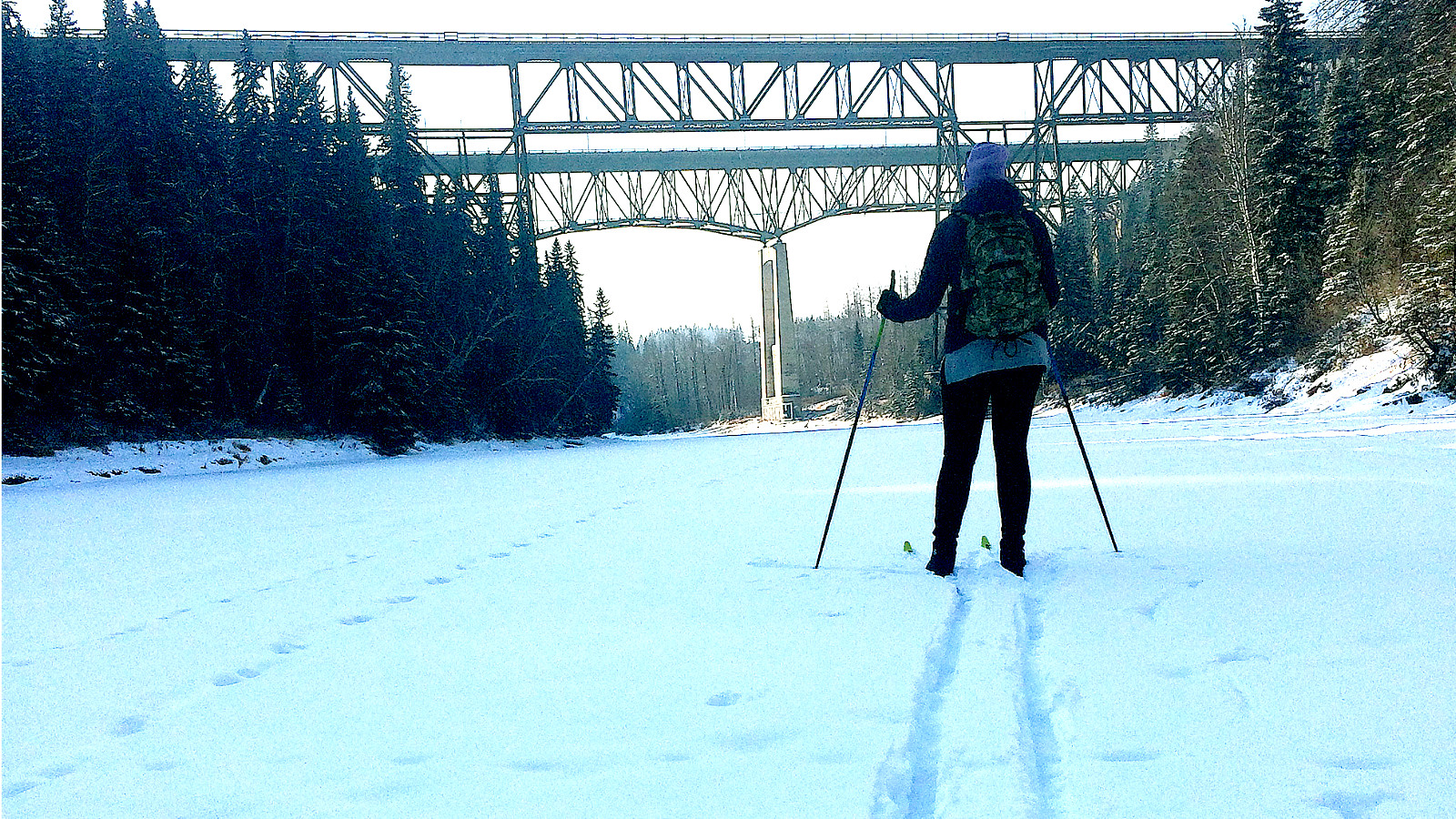
A few weeks ago my perspective changed. Taking off from the Pembina River Provincial Park my friend and I Nordic skied upstream on the frozen river towards the two bridge crossings.
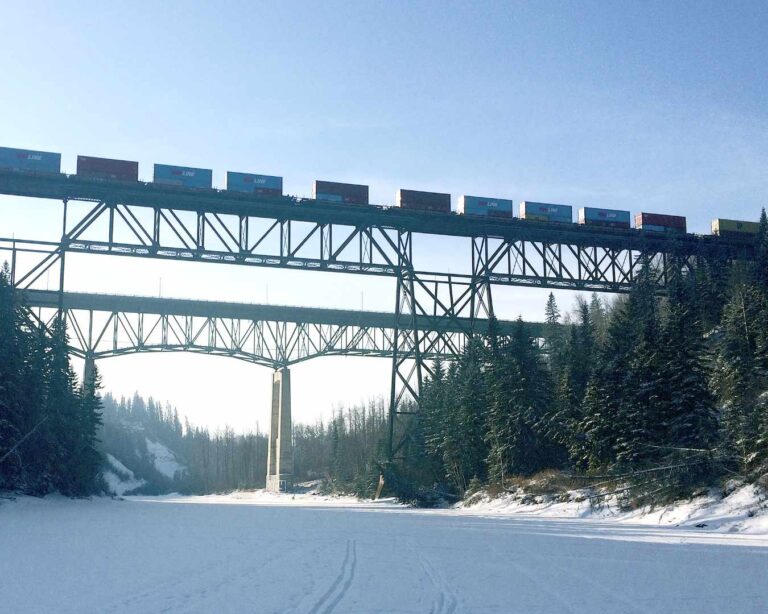
Steep sandstone embankments created a mountainous illusion and thick ice flow that thawed and froze in early winter skirted the bottom of the embankments. As we followed the curve of the river I looked up to see the illusion of stacked bridges. A rail bridge over top of a car bridge. The industrial architecture was immense and compounded by the illusion.
“This reminds me of New York,” I said to my friend.
“This reminds me of Switzerland,” she said.
Whatever it was, we were transported to another place far away from this part of Alberta. I would even say we were transported to another time. I am by no means an architect but it seems to me bridges made today favour a sleek modern design, that features soft arches and blends with the urban environment and doesn’t look so…industrial. When you look at the Pembina River viaduct you immediately know that this was purpose built infrastructure that has a history. It is laden with steel, it has abrupt corners, and lacks any hint of frivolity.
The Pembina River viaduct was built by the Grand Trunk Pacific Railroad between 1909-1910. The bridge was designed, and built first in Scotland. It was then dismantled and shipped across the Atlantic, and brought to the “end of the steel” also known now as Entwistle, Alberta.
Before the actual construction of the bridge could start the crews built a massive false bridge and scaffolding out of wood. This was later removed once the viaduct was open for use.
The completed bridge is 910 ft long and 214 ft tall. It is the second tallest rail bridge in Alberta and after 111 years it is still in use.
As we moved closer and closer to the bridge the illusion revealed itself and the Yellowhead highway bridge on Hwy 16 was now running alongside the viaduct.
The Yellowhead highway bridge has more of an industrial modern look and is heavily used. It was built from 1961-1962 with a completed height of 207 ft. It’s 900 ft long and was, for a time, the highest bridge in Alberta.
From the basin of the Pembina River it was easy to see that the construction of both of these bridges were an architectural feat. Developers would have been dealing with 1909 technology, high embankments, a wide valley and limited existing infrastructure.
I could not imagine what it must have been like to be a worker on such a project.
These concrete and steel constructions represented progress as the west continued to be opened up and a route to the Pacific through the Rockies was punched through. They demonstrated man and woman’s ability to conquer the land and ushered in the industrial age.
The rail line brought homesteaders and economic development and now both bridges bring the global economy to our door steps.

Golfing Drayton Valley
But there was lots to like. The course itself is in very good shape, in spite of our efforts to dig parts of it up with an over enthusiastic pitching wedge. And it was great to get out in some early morning sunshine.

Golfing Breton and Birchwood
A one day golf extravaganza, 27-holes, 3-courses. Breton Municipal Golf Course, Big Tee in Breton and The Village Golf Course in Birchwood.


Fumbles and bumbles at Rose Creek
We were about 45 minutes into what turned out to be a very thick bushwack. I was mid-lunge and my ski was looking like a “U” as I tried to get over a fallen tree when my aunt asked, “How much weight do you think we can put on our skis before they break?” I paused, unweighted my ski and looked around to see if there was another way through.

Five scenic bike rides near Drayton Valley
Here are five rides that are moderate in length, located on quiet secondary highways, and offer a variety of views not more than 40 minutes from Drayton Valley.

Five hidden fishing gems in Alberta’s West Country
If your idea of a great summer includes trading cell service for campfires and crowds for calm waters, you’re in for a treat. Out in Brazeau Country—just 40 minutes west of Drayton Valley—there’s a wild slice of Alberta that’s perfect for escaping the noise and diving into real-deal wilderness vibes. Think remote lakes, winding rivers, and chill campsites where you can cast a line, crack a cold one, and feel like you’re the only person in the world.

Experiencing the finer arts in the valley
Art galleries can be an inspiring place to visit but they can also be baffling.